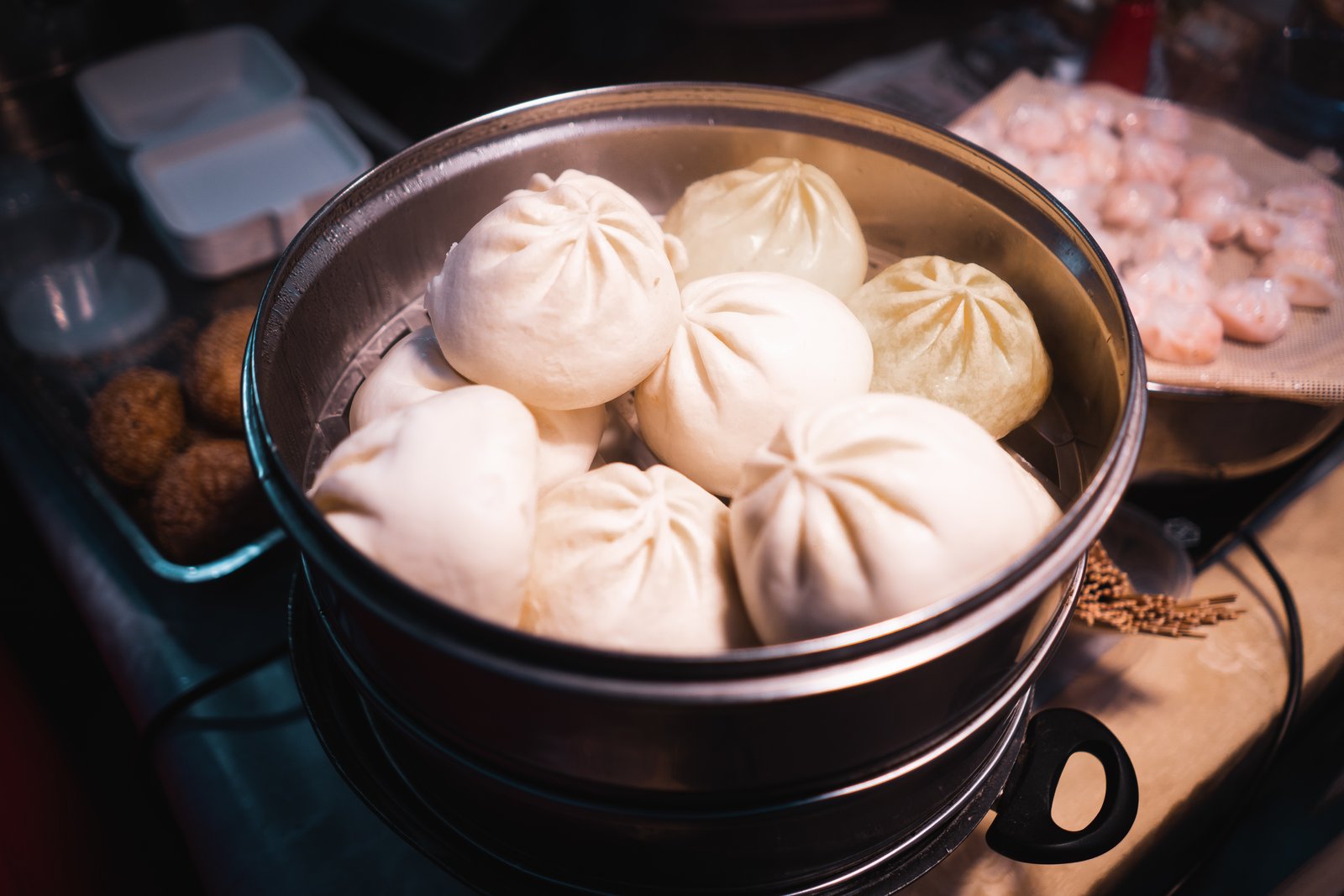
Baozi (包子, bāozi) are steamed buns made from leavened wheat dough wrapped around a filling — pork and cabbage, red bean paste, mushrooms, whatever the shop makes. They are sold by the basket from breakfast stalls and steamer carts across China, eaten in the hand, and they are one of the few Chinese foods that almost every country in the region has its own version of.
The question people actually arrive with is what to call them. Dumpling? Bun? Bread? Dim sum? The honest answer is that English has no category that fits, and the reason is more interesting than a translation problem: for several centuries, Chinese did not sort them cleanly either.
Why the category question has no clean answer
Each of the English options fails in a specific way.
Dumpling, in English, has come to cover almost anything small with a filling — jiaozi, wontons, momos, pierogi, gyoza. Baozi fit that loosely, but the word also implies a thin unleavened wrapper, and a baozi wrapper is thick, soft and risen. If you call a baozi a dumpling in front of someone who grew up eating both, they will correct you.
Bread is closer to the dough but wrong about the method: baozi are steamed, not baked, and they come out white and soft rather than browned. There is no crust.
Dim sum is a category of occasion, not of food. It means the Cantonese teahouse meal, and some baozi — char siu bao, for instance — are served at it. Most baozi are not. Calling a breakfast-stall pork bun in Xi’an “dim sum” is like calling a sandwich “brunch.”
The category that would actually fit is the Chinese one: 面食, wheat-flour food, a bracket that holds noodles, buns, pancakes and dumplings together and sorts them by how the dough is handled rather than by what shape it ends up. English does not have that bracket.
Chinese did not sort them cleanly either — at first
Here is where the assumption most people are taught starts to come apart. The rule usually given in English is simple: mantou is the plain one, baozi is the filled one. It is a useful rule today. It has not always been true.
Hu Sihui’s 饮膳正要, presented to the Yuan court in 1330, contains a chapter of recipes for the imperial kitchen. Four of them are for 馒头 — mantou. Every single one has a filling.
仓馒头 羊肉 羊脂 葱 生姜 陈皮各切细
上件,入料物、盐、酱,拌和为馅。
Granary mantou. Mutton, mutton fat, scallion, fresh ginger, tangerine
peel, all finely cut. Combine with the seasonings, salt and sauce, and mix
into a filling.
The others are 鹿奶肪馒头 (deer-fat mantou), 茄子馒头 (eggplant mantou, where the filling goes inside the eggplant and the whole thing is steamed), and 剪花馒头, which is the one worth reading twice:
上件,依法入料物、盐、酱拌馅包馒头,用剪子剪诸般花样,蒸,用胭脂染花。
Mix the filling with seasonings, salt and sauce as prescribed and wrap the
mantou; cut various flower patterns into it with scissors, steam, and
color the flowers with rouge.
Scissors, then steam, then rouge. Note also the verb: 包馒头 — to wrap a mantou. The word we now translate as “bun with a filling” is being used as a verb on the word we now translate as “bun without one.”
The same chapter has a 包子 as well, 天花包子, made with mutton, mutton fat, mutton tail fat, scallion, tangerine peel and ginger — a filling almost identical to the mantou recipes — wrapped in a thin white-flour skin and steamed.
That is the palace. The street said the same thing. Wu Zimu’s 梦梁录, describing the food shops of Hangzhou in the thirteenth century, gives an inventory from the pastry trade that runs to dozens of items. Two of them sit a few names apart:
……水晶包儿、笋肉包儿、虾鱼包儿、江鱼包儿、蟹肉包儿、鹅鸭包儿……
……糖肉馒头、羊肉馒头、太学馒头、笋肉馒头、鱼肉馒头、蟹肉馒头、肉酸馅……
…crystal bao, bamboo-shoot-and-pork bao, shrimp-and-fish bao, river-fish
bao, crab-meat bao, goose-and-duck bao… sugar-and-pork mantou, mutton
mantou, Imperial Academy mantou, bamboo-shoot-and-pork mantou, fish
mantou, crab-meat mantou, sour-filled meat…
A crab-meat bao and a crab-meat mantou, on the same shop’s list. Same filling, two different category words, one inventory.
The vegetarian shops in the same passage sold 假肉馒头 — mock-meat mantou — along with bamboo-shoot mantou, wrapped-and-steamed mantou and spinach-and-fruit mantou. All filled. All called mantou.
And then, at some point, it did
Five and a half centuries later the line is there.
Fu Chongju’s 成都通览, a survey of Chengdu printed in 1909, lists what was sold on the city’s streets, with prices. Steamed plain buns and filled buns appear as separate items, at separate prices:
蒸馍 童子街有铺,三、四文一个。
……
糖包子 每个四文。
洗沙包子 四文。
附油包子 四文。
干菜包子 四文。
大肉包子 六文,九龙巷口。
南虾包子 四文。
火腿包子 六文。
口蘑包子 十二文。
Steamed mo. There are shops on Tongzi Street; three or four cash each.
… Sugar bao, four cash each. Sweet-bean-paste bao, four. “Fuyou” bao,
four. Dried-vegetable bao, four. Big-meat bao, six, at the mouth of
Jiulong Lane. Southern-shrimp bao, four. Ham bao, six. Kou-mushroom bao,
twelve.
Plain steamed bread at three or four cash; filled buns from four to twelve. By 1909, in this city, a compiler listing street food kept them apart and priced them apart.
So the distinction is real. It is just younger than the food.
Three snapshots — a thirteenth-century Hangzhou shop list, a fourteenth-century palace kitchen, a 1909 Chengdu street survey — are not a continuous history, and we are not claiming one. Chengdu in 1909 is one city in one year. But taken together they show something more useful than a rule: they show a category line settling into place, and they show that it was not always there.
One more thing in that price list, because nobody expects it. The most expensive bun on the street was the mushroom one. A sugar bun cost four cash; a ham bun six; a 口蘑 bun twelve — three times the sugar bun, twice the ham. 口蘑 is a dried mushroom brought in from beyond the northern frontier. What made that bun expensive was not the filling’s richness but how far it had traveled.
What actually makes a baozi rise
The dough is the part of the definition that holds up.
The 1930 gazetteer of Jiading County sorts buns not by filling but by how far the dough is allowed to ferment, and names two kinds. The loosely raised sort — 松酵 — is made with wine lees or alkaline water, fermented, and steamed; that is the ordinary breakfast baozi, soft and puffed, and the gazetteer records that these are eaten straight from the basket, which is why they were called 出笼馒头, “out-of-the-steamer mantou.”
The tightly raised sort — 紧酵 — is made with plain water and flour and barely rises at all, which is what makes a wrapper thin enough for xiaolongbao. That is a different line, with its own page.
We are reading that gazetteer in a modern Chinese rendering rather than the original classical text, so we are describing what it records rather than quoting it.
Baozi and mantou today
The working rule most people are given is the one to use: today, in most of China, mantou means a plain steamed bun and baozi means a filled one.
Two footnotes. In Jiangnan the older usage survives — the small filled buns of Shanghai and Jiading are still called 馒头 locally, not 包子. And a shengjian bao is pan-fried rather than steamed, with a crisp base; it is a Shanghai specialty and a different thing again.
The same bun, in a dozen places
A steamed filled bun turns up across Asia, and readers usually arrive having met one of them rather than the Chinese original.
Siopao is the Philippine version, typically larger, often filled with sweetened pork (asado) or a salted egg.
Nikuman is the Japanese one, sold hot from convenience stores in winter.
Momo, in Nepal and Tibet, is usually smaller and is closer to a dumpling than to a bun — thin wrapper, often steamed in a tiered basket.
Gua bao is not a wrapped bun at all but a folded flat one, closed around braised pork like a taco; it is a Fujian and Taiwan form.
Char siu bao, the Cantonese barbecue-pork bun, comes both steamed and baked, and is the one most likely to appear on a dim sum trolley.
We are describing these as they are eaten now. We have not worked from primary sources on any of them, and we are not going to tell you which came from which.
A note on the name
包 means to wrap; 子 is a noun suffix that does a lot of quiet work in Chinese food names. So the word says, roughly, “wrapped thing” — which is exactly as vague as the category problem this page started with.
It is pronounced bāo-zi, first tone then neutral — closer to “bow” (as in taking a bow) than to “bough.”
One disambiguation, because it sends people here by mistake: 宝子 (bǎozi, third tone) is a recent piece of Chinese internet slang, an affectionate term of address roughly like “babe.” Different characters, different tone, nothing to do with food.
Frequently Asked Questions
What is baozi made of?
Leavened wheat-flour dough wrapped around a filling and steamed. Common fillings are pork with cabbage or scallion, sweetened red bean paste, mushrooms and vegetables, or char siu pork in the Cantonese version.
Is baozi a dumpling?
Not in the sense most English speakers mean. A dumpling wrapper is thin and unleavened; a baozi wrapper is thick, soft and risen. In Chinese the two belong to different groups, sorted by how the dough is made.
What is the difference between baozi and mantou?
Today, baozi have a filling and mantou do not. That rule is reliable now but not old: a 1330 imperial recipe collection gives four mantou recipes, all of them filled, and a thirteenth-century Hangzhou shop list has crab-meat bao and crab-meat mantou on the same inventory.
Is baozi dim sum?
Some baozi are served at dim sum — char siu bao especially. But dim sum is a Cantonese teahouse meal, not a food category, and most baozi in China are breakfast food eaten nowhere near a teahouse.
What does baozi taste like?
The wrapper is mild, soft and slightly sweet; the flavor comes from the filling. A pork baozi is savory and juicy, closer to a meatball in a soft roll than to anything baked.
Is baozi healthy?
It is a steamed wheat bun with a filling, so it is not fried, and the filling decides most of the rest. Pork fillings carry more fat than vegetable ones. We are not nutritionists and would not want to be your source on that.
Is baozi halal?
Pork is the most common filling, so the default answer is no. Halal baozi are widely made in Muslim communities in China, usually with mutton or beef — the Hui restaurant trade is built on them. As always, ask at the stall.
How do you pronounce baozi?
bāo-zi: first tone on 包, neutral tone on 子. The first syllable rhymes with “now,” not with “no.”
Where does baozi come from?
China, with filled steamed buns documented in Chinese sources for at least eight centuries. We cannot give you an inventor or a founding date, and accounts that do are not supported by anything we have been able to find.
Sources
Meng Liang Lu 梦梁录, Wu Zimu 吴自牧, Song — 荤素从食店
Yinshan Zhengyao 饮膳正要, Hu Sihui 忽思慧, Yuan — 聚珍异馔
Chengdu Tonglan 成都通览, Fu Chongju 傅崇矩, 1909 — 成都之街市普通食品
Jiading Xian Xuzhi 嘉定县续志 (Jiading County Gazetteer, Continued), 1930 — 物产·饮馔之属