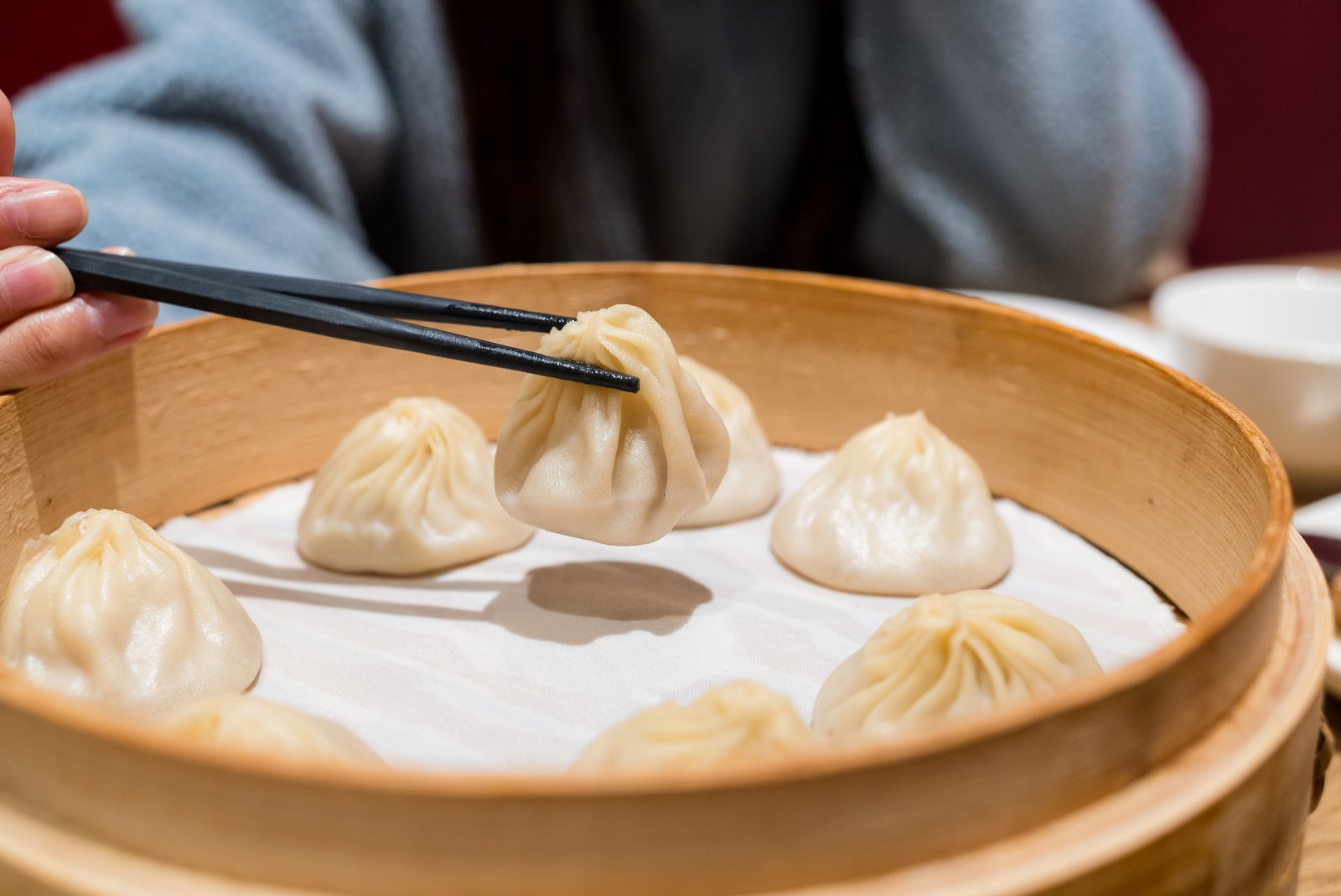
Xiaolongbao (小笼包) are small steamed buns with a hot, liquid filling: a thin, barely-leavened wrapper, a lump of seasoned pork, and a mouthful of soup that is not poured in but forms during cooking. They are sold by the basket, eaten in one bite or two, and they come from Jiading — now the northwestern edge of Shanghai.
In English they are almost always called soup dumplings. That translation is useful and it is also the reason most of what gets written about them is confused, because the Chinese name says nothing about soup.
What the name actually says
Broken into its parts, 小笼包 is 小 (small), 笼 (steamer basket), 包 (bun). Small-basket bun. The name describes the vessel — a stacking bamboo steamer about the width of a saucer — and nothing else.
In Jiading and Shanghai the older and more local word is not 包 but 馒头 (mantou). Elsewhere in China 馒头 means a plain steamed roll with nothing inside it. In this part of Jiangnan it means a filled bun, and the full traditional name of the dish is 小笼馒头 — small-basket mantou.
This is not a quibble. It is why the 1930 gazetteer of Jiading County files the whole subject under 馒头 rather than under 包子, and why its entry begins by sorting buns not by what is inside them but by how the dough is raised:
馒头有紧酵、松酵两种。紧酵以清水和面为之,皮薄馅多。
南翔制者最著,他处多仿之,号为翔式。
There are two kinds of mantou, tight-raised and loose-raised. The
tight-raised are made with plain water and flour; the skin is thin and
the filling generous. Those made at Nanxiang are the most celebrated,
and other places widely imitate them, calling the style “Xiang-style.”
紧酵 — “tight-raised” — is the technical heart of the dish. The gazetteer’s own definition of it is minimal and precise: plain water and flour. No leavening agent is named, and without one the dough stays dense enough to be rolled paper-thin and will not puff in the steamer and swallow the filling. 松酵, “loose-raised,” is the ordinary risen dough of a breakfast bun. One word separates a xiaolongbao from a baozi, and it is a word about how far you let the dough go.
The gazetteer also records something we would otherwise only have from repetition: that by 1930 “翔式” — Xiang-style, after the town of Nanxiang — was a live commercial category that other places used for their imitations.
One honest caveat belongs here, and it is the kind of thing English write-ups leave out. Nanxiang is a town in Jiading County, and this is Jiading County’s own gazetteer. A county record praising the county’s own product is not neutral testimony. What it does establish is that the name existed and traveled — a compiler would not claim other places were copying a style unless the style had a name people recognized.
How the soup gets inside
Nothing is injected, and nothing is poured. The soup goes in solid.
Pork skin, and often bones, are simmered until the liquid is thick with gelatin, then chilled until it sets into a firm aspic. That aspic is diced and mixed into the raw pork filling like any other ingredient. The wrapper is closed around a cold, solid lump. In the steamer the gelatin melts, and what was a solid becomes the soup.
This is why xiaolongbao are served in the basket they were cooked in, why they are eaten immediately, and why a cold one is a different and much sadder object. It is also why the wrapper has to be thin and barely-leavened: it has to hold a liquid that did not exist when the bun was sealed.
Tangbao is a different word, from a different place
Here is where English loses information.
小笼 names the basket. 汤包 (tangbao) names the soup. They are not two halves of one term and they did not come from the same tradition — they are two separate ways of classifying, from two separate places, and they happen to overlap.
A Republican-era gazetteer of Ganquan County, in Yangzhou, has no interest in steamers at all. Its entry sits under 包子, and it sorts by what is inside:
包子肉馅中多汤者,谓之汤包。或菜馅。蒸时皆衬松毛。
Buns with a great deal of soup in the meat filling are called tangbao.
Some have vegetable filling. When steamed they are all lined with pine
needles.
Two county records, two systems. Jiading classifies by fermentation and by where the best ones are made. Yangzhou classifies by how much liquid is in the filling, and throws in a detail that no one in Shanghai would recognize: the baskets are lined with pine.
小笼 → the container
汤包 → the contents
English “soup dumpling” flattens both axes into one phrase, which is why the internet argues about whether a Yangzhou crab tangbao “counts.” The question is malformed. It counts on one axis and not on the other.
Filled steamed buns are old, and buns with liquid inside them are older than Nanxiang by six centuries.
Chinese snack names often pick one axis and leave the rest silent. Tanghulu names a kind of sugar and a gourd, and says nothing at all about the fruit on
the stick — which is why one word covers hawthorn, grapes and strawberries without strain.
What the Song records show
Filled steamed buns are old, and buns with liquid inside them are older than Nanxiang by six centuries.
清异录, a tenth-century collection attributed to Tao Gu 陶穀, preserves an anecdote about the Tang official Zhao Zongru, who heard of an imperial breakfast dish called 玉尖面, “jade-tip noodle.” Its filling was 消熊栈鹿 — the book glosses these as bears so fat they were called 消, and deer fattened on double rations, called 栈 — and when Zhao asked what shape it was, the answer was that it was simply the 出尖馒头, the pointed-top mantou, that ordinary people ate. Filled steamed dough was already unremarkable enough to be described by pointing at street food.
The name is worth a second look, because it is not a noodle. 面 is usually translated that way, but the character 面 means flour — which is why a steamed, filled bun could carry it in its name without anyone finding that strange.
东京梦华录, Meng Yuanlao’s recollection of Kaifeng before its fall in 1127, lists bun shops by their trade names — 王楼山洞梅花包子 on the imperial avenue, 鹿家包子 west of the palace corridor — sitting among the pastry sellers and the meat-pie stalls. Buns were a branded business.
The closest thing to our subject is in Wu Zimu’s 梦梁录, describing Hangzhou a century later. Among the specialist taverns it records the 包子酒店 — bun taverns — and what they sold:
更有包子酒店,专卖灌浆馒头、薄皮春茧包子、肉包子、鱼兜杂合粉、灌大骨之类。
There were also bun taverns, selling only guanjiang mantou, thin-skinned
“spring cocoon” buns, meat buns, yu dou za he fen, and guan dagu.
Two items on that list are dish names we cannot securely identify, and we have left them in romanisation rather than guess. The one that matters is legible. 灌 means to pour in, to fill with liquid, and it appears twice on a single shop’s board: 灌浆馒头, “poured-broth mantou,” and 灌大骨, something done to a marrow bone. Elsewhere in the same book, in the section on snack and pastry shops, the list of buns includes 蟹肉包儿 — crab-meat buns.
So by the thirteenth century, in Hangzhou, there were shops whose specialty was a bun with liquid in it, and there were crab buns, and both were ordinary enough to be listed without explanation.
And what none of them show
Not one of these sources says the buns were small. Not one mentions a bamboo basket. None uses the word 小笼, and none connects any of this to Jiading, which in that period was a cotton-weaving county in another prefecture entirely.
Between 灌浆馒头 in Hangzhou and 紧酵 mantou in Nanxiang there are roughly seven hundred years, and we cannot show you a single link in the chain. The technique of putting liquid inside a steamed bun is demonstrably old. The dish you order today — that name, that dough, that basket, that town — belongs to the nineteenth century.
There is a widely repeated account of how it began: a pastry-shop owner in Nanxiang named Huang Mingxian, who took over a shop called Rihuaxuan in 1871 and began experimenting with small steamed buns. Modern local histories tell it in detail, down to his birth name and the year he was adopted. We have not found a contemporary record of it. That does not make it false, and we have not searched everywhere it might be. It means that as of now it is an account handed down rather than a document, and we would rather say so than repeat it as established.
Note also what the story claims in its Chinese telling: that 1871 was the year he inherited the shop and 开始试制 — began trialling — small steamed buns. English versions render this as “invented in 1871.” Those are different sentences.
Not everything with soup in it is a xiaolongbao
Several regional dishes get translated into English as soup dumplings. They are not the same thing and, on the evidence above, they were never a single family.
Wuxi, in Jiangsu, has its own small steamed buns, noticeably sweeter than Shanghai’s. We have found no primary record for them, and so we say nothing further here.
Yangzhou and Jingjiang make 蟹黄汤包, crab-roe tangbao — much larger, sometimes a single bun to a basket, often drunk through a straw. The Ganquan gazetteer quoted above belongs to this tradition, not to Nanxiang’s.
Kaifeng, in Henan, has 灌汤包, which carries the same 灌 as the Song records and is a northern line entirely.
And 生煎包, the pan-fried Shanghai bun with a crisp base, is not a xiaolongbao at all: it is fully leavened, it is fried, and it belongs on its own page.
Frequently Asked Questions
What does “xiaolongbao” mean?
Small-basket bun: 小 small, 笼 steamer basket, 包 bun. The name describes the bamboo steamer it is cooked and served in. Soup is not mentioned. The older local name is 小笼馒头, small-basket mantou.
How is the soup put inside a xiaolongbao?
It is not put in as liquid. Pork skin is simmered into a gelatin-rich stock and chilled into a firm aspic, which is diced and mixed into the raw filling. Steam melts it, and the solid becomes soup.
Are xiaolongbao and soup dumplings the same thing?
In English, usually yes — “soup dumpling” nearly always means xiaolongbao. In Chinese the two ideas are separate: 小笼 names the basket, 汤包 names the soup, and they come from different regional naming traditions.
Where are xiaolongbao from?
Nanxiang, a town in Jiading, now part of northwestern Shanghai. A 1930 Jiading county gazetteer records that Nanxiang’s were the most celebrated and that other places imitated them under the name “Xiang-style.”
Are xiaolongbao Shanghainese?
Today, yes — Nanxiang is inside Shanghai and the dish is a Shanghai emblem. Historically the distinction matters: Jiading was a separate county, and this is a Jiading dish that Shanghai absorbed.
How old are xiaolongbao?
The dish as it exists now dates to the nineteenth century. Steamed buns with liquid inside are far older — thirteenth-century Hangzhou had taverns whose specialty was “poured-broth mantou” — but no source connects those to Nanxiang, and we do not claim a line between them.
Are xiaolongbao the same as baozi?
No, and the difference is in the dough. Xiaolongbao use 紧酵, “tight-raised” dough made with plain water and flour, which stays thin and dense. Baozi use risen dough that puffs in the steamer. The 1930 Jiading gazetteer sorts buns by exactly this distinction.
How do you eat a xiaolongbao without burning yourself?
Lift it by the pleated top, set it on a spoon, bite a small opening in the side, and let the soup out before eating the rest. The filling is hotter than it looks, because it was liquid before it ever met the air.
Sources
Qingyilu 清异录, attributed to Tao Gu 陶穀, tenth century — 玉尖面
Dongjing Meng Hua Lu 东京梦华录, Meng Yuanlao 孟元老, Song
Meng Liang Lu 梦梁录, Wu Zimu 吴自牧, Song — 酒肆; 荤素从食店
Jiading Xian Xuzhi 嘉定县续志 (Jiading County Gazetteer, Continued), 1930 — 物产·饮馔之属
Ganquan Xian Xuzhi 甘泉县续志 (Ganquan County Gazetteer, Continued) — 卷七下 物产考·食物之属