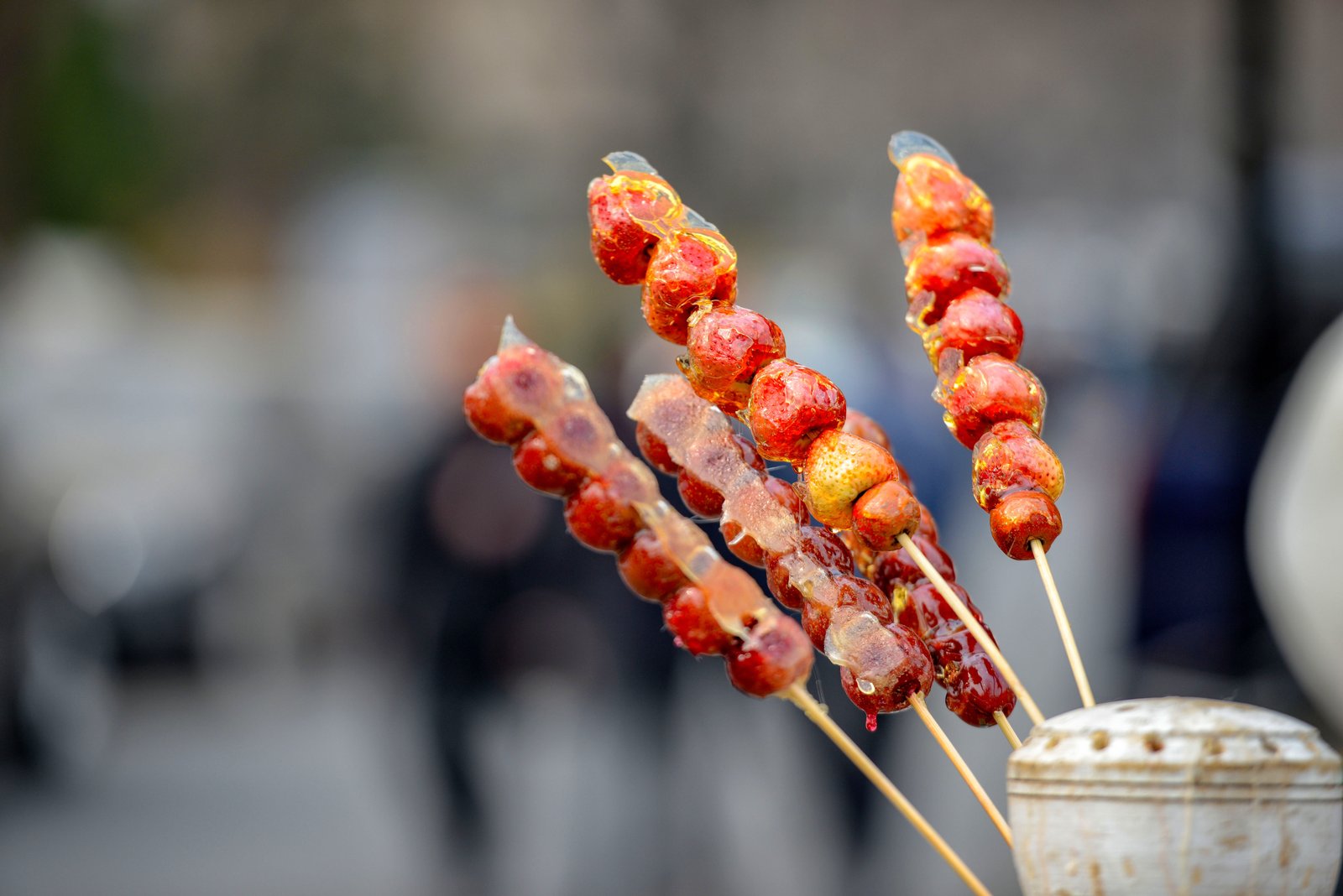
Search for this snack in English and you will find it spelled two ways. Some pages call it tanghulu. Others call it bingtanghulu, or bing tang hulu. Nobody explains the difference, and if you go looking for one today you will not find it, because there is no longer any difference to find.
There used to be. The longer name carries a word the short one drops, and in the oldest records we have been able to read, that word was doing real work. It stopped doing that work at some point in the last century, and the name kept it anyway.
This page is about what that word was for. Along the way it answers the questions people actually type: what is on the stick, what the name means, and what the oldest Beijing records we have been able to read actually say.
What tanghulu is
Fruit on a stick, dipped in molten sugar, left to set into a shell. The shell is hard and thin and shatters when you bite it. The fruit underneath is cold and soft and usually sour. That contrast — glass, then juice — is the whole point.
The classic fruit is hawthorn, which in northern China is a small red thing about the size of a large cherry, sharp enough that almost nobody eats it plain. Coated in sugar it becomes something else. Modern stalls also use strawberries, grapes, mandarin segments and kiwi, which is what most of the
short videos show.
It is sold from carts and stalls, not restaurants, and in Beijing it was historically a cold-weather item. Why that matters turns out to be more interesting than it sounds, and we come back to it below.
Tanghulu, bingtanghulu, and three other names
The two English spellings correspond to two Chinese names: 糖葫芦 tanghulu and 冰糖葫芦 bingtang hulu. The difference is at the front. 糖 táng is sugar. 冰糖 bīngtáng is rock sugar — the large clear crystals. A specific kind of sugar, not sugar in general.
So bing- is not “ice”. English readers meet the syllable and reasonably think of something frozen, and cold really is part of this snack, but that is a coincidence of sound. The word is naming the sugar.
The oldest description we have found that gives the thing a name at all is from 1906, and the name it gives is the longer one:
冰糖壶卢乃用竹签,贯以葡萄、山药豆、海棠果、山里红等物,蘸以冰糖,
甜脆而凉。冬夜食之,颇能去煤炭之气。

Bingtang hulu is made with a bamboo skewer, threaded with grapes, yam
bulbils, crabapples, shanlihong and the like, dipped in rock sugar,
sweet and crisp and cold. Eaten on a winter night, it does a good deal
to dispel the smell of coal.
That is from Fucha Dunchong’s Yanjing suishi ji, a record of the Beijing year published in 1906, in the section on foods that appear from the tenth month onward. The name in the entry is bingtang hulu, with the rock sugar specified, not tanghulu.
Why specify? Because at the time there was something to specify against. Liang Shiqiu, writing decades later in Taiwan about the Beijing he grew up in, remembered that 北平糖葫芦分三种 — Beiping tanghulu came in three kinds. One used maltose syrup. One used white sugar, which dried to a pale bloom. And the third, which he called 正宗, the orthodox one, was made with rock sugar: 薄薄一层糖,透明雪亮 — a thin layer of sugar, transparent and bright.
Three sugars, three products, one family name. Under those conditions “bingtang” is not decoration. It tells you which of the three you are buying.
Today it tells you nothing. The maltose and white-sugar versions are not what anyone means by the word any more, and tanghulu and bingtanghulu have collapsed into two labels for one thing. If you have been using them interchangeably, you have been using them correctly. The two names survive from a time when the choice was real.
The same body of recollection remembers that the name was not standard across China either. Tang Lusun, another Beijing-born writer recalling the city from Taiwan, noted that the south called it 糖球 tangqiu, sugar ball; Tianjin called it 糖墩 tangdun, sugar mound; and Beiping called it 糖葫芦. Three cities, three metaphors, one snack. English picked one of them and transliterated it.
The other half of the name is not an ingredient
Having dealt with the sugar, there is the rest of the word. 葫芦 húlu is the bottle gourd — the calabash, the pinched-waist gourd that gets dried out and made into containers.
No gourd goes anywhere near this snack. The 1906 entry lists four things on the skewer and none of them is a gourd. So whatever 葫芦 is doing in the name, it is not naming an ingredient, which already makes this name unlike almost every other Chinese snack name an English reader is likely to meet.
The 1906 book is useful here for a second reason: it writes the word as 壶卢, an older spelling of the same gourd, and it attaches that word to things that are not gourds. In the same tenth-month chapter there is 油壶卢, a cricket, kept through the winter for its song and sold by the pair. A cricket is not a gourd either.
The usual explanation is the obvious one — a row of round fruits on a stick, bulging and narrowing, bulging and narrowing, looks like a gourd. We have not found a source from the period that says so outright, so treat that as the natural reading rather than a documented fact. What the records do establish is the harder half: the word is there, and the thing it names is not.
That is the part that does not survive translation. A Chinese reader hearing 冰糖葫芦 hears a kind of sugar and the name of a gourd. An English reader hearing “tanghulu” hears three syllables and a sound. Both words inside have gone quiet.
The reverse case is just as common in Chinese food names: a character that looks like it names the dish but is really naming a raw material. 麵 is written with the wheat radical and means flour; noodles attached themselves to it later, not the other way round.
What is actually on the stick
English sources will tell you tanghulu is traditionally made with hawthorn. That is true, and it is also incomplete, and the incompleteness is visible in the same records.
The 1906 entry names four things on the skewer: grapes, yam bulbils, crabapples, and shanlihong — and then adds 等物, “and the like”, which means even four was not the full list. Liang Shiqiu’s recollection names eight: crabapple, yam, yam bulbils, dried apricot, grape, tangerine, water chestnut,
walnut. Tang Lusun describes particular combinations sold at particular stalls — large shanlihong stuffed with red bean paste and decorated with melon seeds, peeled water chestnuts, a grape paired with a slice of hawthorn jelly.
So hawthorn is the standard, not the whole of it. Liang Shiqiu says as much: 以山里红为正宗, shanlihong is the orthodox one — the same word he used of rock sugar, and it carries the same force, which is a judgment about quality rather than a statement of fact.
One more thing gets lost in English. 山里红 shanlihong and 山楂 shanzha are two Chinese names in common use, 山里红,即山楂. English has one word, hawthorn, and it covers both. When an English recipe says “hawthorn”, the Chinese behind it might be either.
The cold is part of the recipe
Read the 1906 entry again and notice where the weather sits in the sentence. 甜脆而凉 — sweet, crisp and cold. 冬夜食之 — eaten on a winter night. The entry itself is filed under foods that appear from the tenth month onward. In the 1758 record quoted below, the closest thing to it appears under the ninth
month, at the Double Ninth festival. Every early description of the thing itself that we have found is dated to the cold half of the year.
That is not scene-setting. Molten sugar has to go from liquid to glass fast enough that it does not soak into the fruit, and in Beijing in 1906 the street did that job. The season was the equipment.
I remember this from my own childhood, walking home from school in winter. There was a pot of sugar on a burner boiling up into big slow bubbles, and the man selling them would steady the pot with one hand, roll a skewer of large hawthorns through it with the other, and drop it onto the board with a smack. Because of the weather the sugar hardened almost immediately. Biting in, the crisp sweetness of the shell and the soft sourness of the fruit arrived at the same moment.
Now look at how it is made today. Modern recipes are consistent: boil the syrup to hard-crack stage, dip, and then immediately plunge the skewer into a bowl of ice water.
The ice bath has replaced the Beijing winter. A step that used to require a season now requires a bowl, indoors, anywhere. That is why something recorded as a tenth-month item in 1906 can be a summer street food in 2026, and it is also why every recipe insists the fruit be bone dry first — without the cold street doing half the work, a film of surface water is enough to ruin the
shell.
One line in the 1906 entry has no modern counterpart at all: 颇能去煤炭之气, it does a good deal to dispel the smell of coal. Beijing then was heated and cooked on coal, and in winter the air carried it. Something cold and sharp and sweet cut through that. It is a reason to eat the thing rather than an
instruction for making it, and it is the sort of detail that only survives when someone bothers to write down what a city was actually like.
What the Beijing records say, and when
Three Beijing books, a century and a half apart at the ends.
- Pan Rongbi’s Dijing suishi jisheng, a record of the Beijing year. In the
seventh-month section on seasonal produce he writes that hawthorn comes in two
kinds, the local sort small and sweet, the imported sort large and sour, and
that it 可以捣糕,可糖食 — can be pounded into cake, can be eaten with sugar.
Two uses, side by side, neither of them with a name.
Then, under the ninth month, at the Double Ninth festival, among the cheap
sweets children sold in the street: 线穿山楂,绕街卖之 — hawthorns threaded on
string, hawked around the streets. Threaded. Sold in the street. On string,
not on a bamboo skewer. And still no name for it — the writer identifies it by
describing what it looks like, because that is all he can do.
- Yang Jingting’s Dumen jilüe, a guide to the capital, in the edition
recut that year. Its food section runs to twenty entries, each a short verse:
the meat market, taverns, eating houses, yellow croaker, Dongpo pork, roast
beef, roast mutton, wonton, mooncakes, dog meat, plum drink. Hawthorn is
there. But hawthorn in this book is a jelly: 山楂蜜糕(又名金糕)
南楂不與北楂同,妙製金糕數滙豐。 Hawthorn honey cake (also called jingao)
Southern hawthorn is not the same as northern hawthorn;
for finely made jingao, Huifeng is the one.
A named product with a named shop. Of the two uses Pan Rongbi had listed in
1758, the cake had arrived in the city with a trade name and a verse about it.
The sugar-coated one is not among the twenty.
- Fucha Dunchong’s Yanjing suishi ji, quoted at the top of this page.
Bingtang hulu: bamboo skewer, four fruits, rock sugar, winter night, coal
smoke. The first time in these three books that the thing has a name of its
own.
It is worth saying plainly what this does and does not show. It shows what was written down in Beijing, and when. It does not show that the snack did not exist earlier, and it cannot, because tanghulu was carried on shoulder poles and sold from stalls, and guides to a city’s named businesses do not list men with baskets. Pan Rongbi’s children with their strings of hawthorn were never going to appear in a commercial directory under any circumstances. Absence from a list of shops is not absence from the street.
Nor do these books say anything at all about how the snack reached Korea orJapan, where it is now hugely popular and has a recent history of its own. We have not read the Korean or Japanese records. We have read three Beijing books, and this is what they say.
A story circulates that the snack was invented as a medicine for a Song dynasty emperor’s consort. None of the books above mentions it. That proves nothing — they are records of the year’s customs, not histories of origin, and they had no particular reason to mention it — but we have not found a contemporary source for the story either, and we have not looked everywhere.
Candy apple, toffee apple, dango
Most English speakers reach for a comparison, and which one depends on where they grew up. Americans say candy apple. British readers say toffee apple. Readers who know Japanese sweets think of dango, which is a different thing entirely but has the right silhouette.
All three are fair enough as first approximations, and the differences are worth knowing. A candy apple is one large sweet fruit; tanghulu is several small sour ones, and the sourness is the design. Liang Shiqiu is blunt about it — hawthorn is 味酸,裹糖则极可口, sour, and wrapped in sugar it becomes very good indeed. The shell is also thinner. The point is a crack, not a layer of
candy to chew through.
And unlike either apple, this was tied to a particular kind of weather, which is the part that has changed most in the last twenty years.
Frequently Asked Questions
Is tanghulu Chinese or Korean?
It is recorded in Chinese sources in Beijing. The three books on this page — 1758, 1864 and 1906 — describe hawthorn sold on strings and then on skewers in the streets of the capital, and the 1906 entry gives it a name. Korea has its own version of the snack and its own recent boom, which we have not researched and do not write about here. What we can tell you is what our sources say,
which is what was in Beijing and when.
Where does tanghulu come from?
Beijing, on the evidence we have read. The earliest description we have found of the thing itself is 1758; the earliest we have found of the name is 1906. Both are records of Beijing customs.
Is tanghulu the same as bingtanghulu?
Today, yes. They are two names for the same snack and you can use either. Historically the longer name specified rock sugar, at a time when maltose and white-sugar versions also existed. The distinction went; the name stayed.
What fruit is tanghulu made of?
Hawthorn is the standard. The 1906 record also lists grapes, Chinese yam bulbils and crabapples; a twentieth-century recollection adds dried apricot, tangerine, water chestnut and walnut. Modern stalls commonly use strawberries and grapes.
What does tanghulu mean in English?
Roughly “sugar gourd”. 糖 is sugar; 葫芦 is the bottle gourd, which is not aningredient — no gourd is involved. Bingtanghulu adds 冰糖, rock sugar.
How do you pronounce tanghulu
Roughly tahng-HOO-loo. In Mandarin it is táng-hú-lu, with the last syllable light and unstressed. The first syllable rhymes with “song”, not with the English word tang.
Is tanghulu halal?
The snack as described in these sources is fruit, sugar and water, with no animal ingredients. That is a description of the recipe, not a ruling. Glazes, colorings and production conditions vary by maker, and we are not a certifying body. Anyone who needs certainty should check with the vendor or with the relevant certifying authority.
SOURCES
Pan Rongbi 潘荣陛, Dijing suishi jisheng 帝京岁时纪胜 (1758), seventh and ninthmonths. Text as printed in the Beijing Guji Chubanshe edition.
Yang Jingting 杨静亭 (ed.), Dumen jilüe 都門紀略, Tongzhi jiazi edition (1864), “Shipin men” 食品門. Quoted in the traditional characters of the woodblock original, from the Fengtu zhi congkan facsimile, pp. 351–358.
Fucha Dunchong 富察敦崇, Yanjing suishi ji 燕京岁时记 (1906), tenth month. Text as printed in the Beijing Guji Chubanshe edition.
Liang Shiqiu 梁实秋, “Suanmeitang yu tanghulu” 酸梅汤与糖葫芦, in Yashe tan chi 雅舍谈吃. A recollection of Beijing written decades after the fact.
Tang Lusun 唐鲁孙, “Beiping de tianshi” 北平的甜食. A recollection of Beijing written decades after the fact.