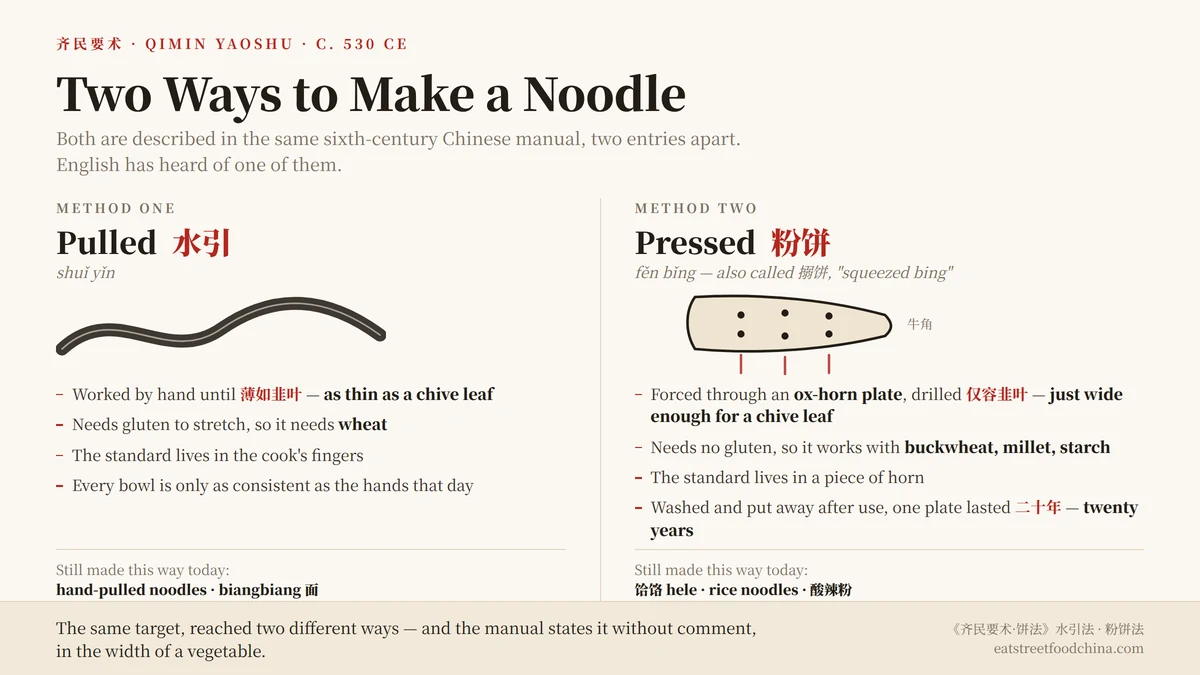
There are two ways to turn dough into a long thin strand. You can stretch it, or you can force it through a hole.
English-language writing about Chinese noodles is almost entirely about the first. Hand-pulled noodles have recipes, videos, restaurant names and a well-worn origin story. The second method has almost nothing, even though it is older in the written record, better documented, and still feeds a large part of northern China every day.
The clearest description of it was written in the sixth century, and it is a description of a tool.
A die cut from ox horn
The Qimin Yaoshu is an agricultural manual compiled by Jia Sixie in the Northern Wei, around the 530s. Its chapter on bing — the general Han-dynasty word for anything made of flour and water — collects more than a dozen flour and starch preparations. One of them is fen bing, and the entry spends most of its length on equipment rather than on cooking.
割取牛角,似匙面大。钻作六七小孔,仅容粗麻线。
若作水引形者,更割牛角,开四五孔,仅容韭叶。
Cut a piece of ox horn, about the size of a spoon’s bowl. Drill six orseven small holes in it, just wide enough to admit a coarse hemp thread.If you want the shape of shui yin, cut another piece of ox horn and openfour or five holes, just wide enough for a chive leaf.
Two dies, then, not one — two plates, each drilled to a different gauge. A fine round gauge and a wide flat gauge, each specified by what will just pass through it. This is a set of noodle plates, described by aperture, in the sixth century.
The rest of the entry explains how the die is mounted and used.
取新帛细绢两段,各方尺半。依角大小,凿去中央,缀角著绢。
以钻钻之,密缀,勿令漏粉。用讫,洗,举。得二十年用。
裹成溲粉,敛四角,临沸汤上搦出,熟煮,臛浇。
Take two pieces of new fine silk, each a foot and a half square. Cut awaythe center to fit the horn, and sew the horn onto the silk. Drill aroundit and stitch it close, so that no batter leaks. After use, wash it andput it away: it will last twenty years. Wrap the mixed batter inside,gather the four corners, and squeeze it out over boiling water; boil until done, and ladle meat broth over it.
A horn plate sewn into a silk bag, squeezed by hand directly over the pot. Not a machine, but not improvised either — a made object, with a stated service life.
That last detail is the one that convinces. Nobody tells you a tool lasts twenty years unless people are actually using it, replacing it, and comparing.
The name records the method
The entry closes by giving the dish a second name.
一名「搦饼」
Nuo bing. 搦 means to press or squeeze down with the hand. The alternative name is, literally, “squeezed bing.”
Chinese food names do this more often than English readers expect. Rou jia mo encodes a grammatical fossil; biangbiang encodes a sound; here the name encodes the gesture that makes the food. If you were looking for evidence that this was understood as a distinct technique rather than an improvisation, the name is it. It is defined by how it is forced out.
Both methods sit in the same chapter, two entries apart
The comparison that makes this interesting is not one a modern writer has to construct. It is already in the source.
Two entries before fen bing, the same chapter describes shui yin — a stretched noodle, and the passage usually cited as an early ancestor of hand-pulled noodles.
挼如箸大,一尺一断……挼令薄如韭叶,逐沸煮。
非直光白可爱,亦自滑美殊常。
Roll it to the thickness of a chopstick and cut it into one-foot lengths … then press it out until it is as thin as a chive leaf, and boil it as the water rises. Not only is it beautifully white and glossy, it is also unusually smooth and good.
Read the two entries together and something small but precise emerges. Both use the same unit of measurement: the chive leaf. In shui yin the cook works the dough by hand until it is 薄如韭叶, as thin as a chive leaf. In fen bing the die is drilled with holes 仅容韭叶, just wide enough for a chive leaf to pass.
The same target, reached two different ways. One puts the standard in the cook’s fingers. The other puts it in a piece of horn, where it stays the same on the thousandth bowl as on the first.
That is the whole difference between the two traditions, and a sixth-century manual states it without comment, in the width of a vegetable.
The stretching method is the one English knows, and Shaanxi’s biangbiang noodles are its most conspicuous living example — a single strip pulled and slapped against the counter until it is as wide as a belt.
Then eight hundred years of nothing
Here is where most accounts of Chinese food history would build a bridge. The technique appears in the sixth century, the dish exists today, so the story writes itself: an unbroken tradition, passed down through the generations.
The surviving record does not support that, and it is worth saying so plainly.
After the Qimin Yaoshu, there is no continuous documentation of pressed noodles. The next clear sighting is in the fourteenth century. In between there is a gap of roughly eight hundred years in which the technique is not described in any text that has been produced.
The sixth-century noodle is also not a northern one. Fen bing is made from 英粉, the finest grade of milled starch, and the finished strands are described as jade-colored; commentators have long connected it to the rice noodles of Hunan and Guangxi. So the die and the buckwheat did not start out together. The mechanism traveled — across grains, across regions, and across the line English draws between a noodle and a starch jelly — and arrived in the north later, attached to a grain that could not be pulled.
What the sixth century gives us, then, is a dated technique and a dated tool. It does not give us the birthday of any bowl now being served.
This matters beyond one dish. Almost every English page about a Chinese food will tell you its age, and most of those ages are produced the same way: find an old text that mentions something roughly similar, and treat the distance between then and now as continuity. The gaps are where the actual history is.
1313: the noodle gets its northern name
The next solid document is Wang Zhen’s Nongshu, an agricultural treatise completed in 1313. Its buckwheat entry describes what people did with the grain.
北方山後諸郡多種,治去皮殼,磨而爲麵,攤作煎餅,配蒜而食;
或作湯餅,謂之「河漏」,滑細如粉,亞於麥麪,風俗所尚,供爲常食。
In the prefectures behind the northern mountains it is widely grown. Thehulls are removed and it is milled to flour; spread on a griddle it makes a pancake, eaten with garlic. Or it is made into tang bing, and this iscalled he lou — smooth and fine as fen, inferior to wheat flour, favoured by local custom and eaten as everyday food.
Three things in one sentence, and all three still hold.
He lou (河漏) is the ancestor of the modern name. Today the dish is written 饸饹, pronounced héle, and the characters are a later phonetic respelling of these ones. The name in the 1313 text is a name for the noodle, not for the grain — the same buckwheat flour, griddled instead, is just a pancake with garlic.
The geography is specific: the prefectures behind the northern mountains. Seven hundred years later, hele is still a regional food of northern Shaanxi, Shanxi, Hebei and Inner Mongolia. The map has barely moved.
And Wang Zhen ranks it. 亞於麥麪 — inferior to wheat flour. Not a slight, but a placement: this was what you ate where wheat did not grow well. Smooth, fine, everyday, second-best.
Why English only knows the pulled kind
That last phrase explains more than it looks like it should.
Pressed noodles are, historically, a coarse-grain food. Buckwheat, sorghum, millet, and later sweet potato and mung bean starch — grains that do not develop much gluten. A dough with little gluten cannot be stretched; pull it and it snaps. Forcing it through a hole is not a rustic shortcut but the only method that works.
Wheat is the opposite. Its gluten is exactly what makes stretching possible, and wheat was the prestige grain — the one Wang Zhen is measuring buckwheat against.
Chinese restaurant food abroad was built by emigrants, and what traveled was overwhelmingly the wheat repertoire: the higher-status grain, the dishes that read as restaurant food rather than as what you eat when the harvest is thin. Hand-pulling also performs. It is a skill you can watch through a window, and it became the visible face of Chinese noodles in English precisely because it is a spectacle.
Pressing is not a spectacle. Someone leans on a lever and noodles fall into water.
The ranking that made this happen is not a modern guess. It is written down in 1313.
One mechanism, several different foods
Once you know what to look for, the same principle turns up across foods that English treats as unrelated.
The cold Beijing dish 漏鱼 — “leaked fish” — is hot starch paste pushed through a perforated gourd ladle into cold water, where each drip sets into a short tadpole shape. Chongqing’s suan la fen is sweet potato starch forced through a press into boiling water. Rice noodles across the south are made by forcing a rice-flour dough through a plate. Hele is buckwheat through a wooden bench press.
A cold jelly, a hot sour soup, a bowl of rice noodles and a northern buckwheat noodle. Four different grains, four food categories that share nothing on a menu — and one mechanism, described with its measurements in the sixth century.
Where to eat it
Hele is sold across northern Shaanxi, Shanxi, Hebei and Inner Mongolia, most often from small shops that make it to order, because pressed noodles have to go straight from the die into the water.
The press itself is worth watching if you get the chance. The traditional 饸饹床子 is a heavy wooden bench with a perforated plate set into it and a lever arm with a piston that fits the cylinder above the plate. Dough goes in, someone puts their weight on the arm, and the noodles come out underneath directly into a boiling pot set below. The tool is bigger than the one in the Qimin Yaoshu and works on the same principle: a measured hole, and force.
Frequently Asked Questions
How old are pressed noodles in China?
The method is described in detail, including the tool, in the sixth-century Qimin Yaoshu. That is a date for the technique. It is not a date for any dish eaten today, and the record between the sixth and fourteenth centuries is largely silent.
Is hele the same thing as the sixth-century fen bing?
No. Fen bing was made from fine milled starch and is usually connected to southern rice noodles; hele is a northern buckwheat noodle. They share a mechanism rather than an ancestry — which is the more interesting fact, because it means the tool moved between grains.
What is hele made from?
Traditionally buckwheat, often mixed with a binder because buckwheat alone has no gluten. Sorghum and other coarse grains are used in some areas, and wheat flour is sometimes added in modern shops.
Why is it called he lou?
The name appears in Wang Zhen’s Nongshu of 1313 written 河漏. 漏 means to leak or drip through. The modern spelling 饸饹 is a later phonetic respelling of the same word.
Is a Chinese noodle press the same as an Italian pasta extruder?
The principle is identical: dough forced through a shaped aperture. The Chinese tools described here are hand- and lever-powered and are used to drop noodles straight into boiling water rather than to produce a dried product.
Why do English sources only talk about hand-pulled noodles?
Partly because pulling is a performance and pressing is not. Partly because pressed noodles are made from coarse grains, which were ranked below wheat — a ranking recorded in Chinese sources as early as 1313 — and the food that emigrated was mostly the wheat repertoire.
Sources
- 齐民要术 (Qimin Yaoshu), Jia Sixie, Northern Wei — the bing chapter, shui yin and fen bing entries
- 农书 (Nongshu), Wang Zhen, 1313 — Hundred Grains section, buckwheat entry