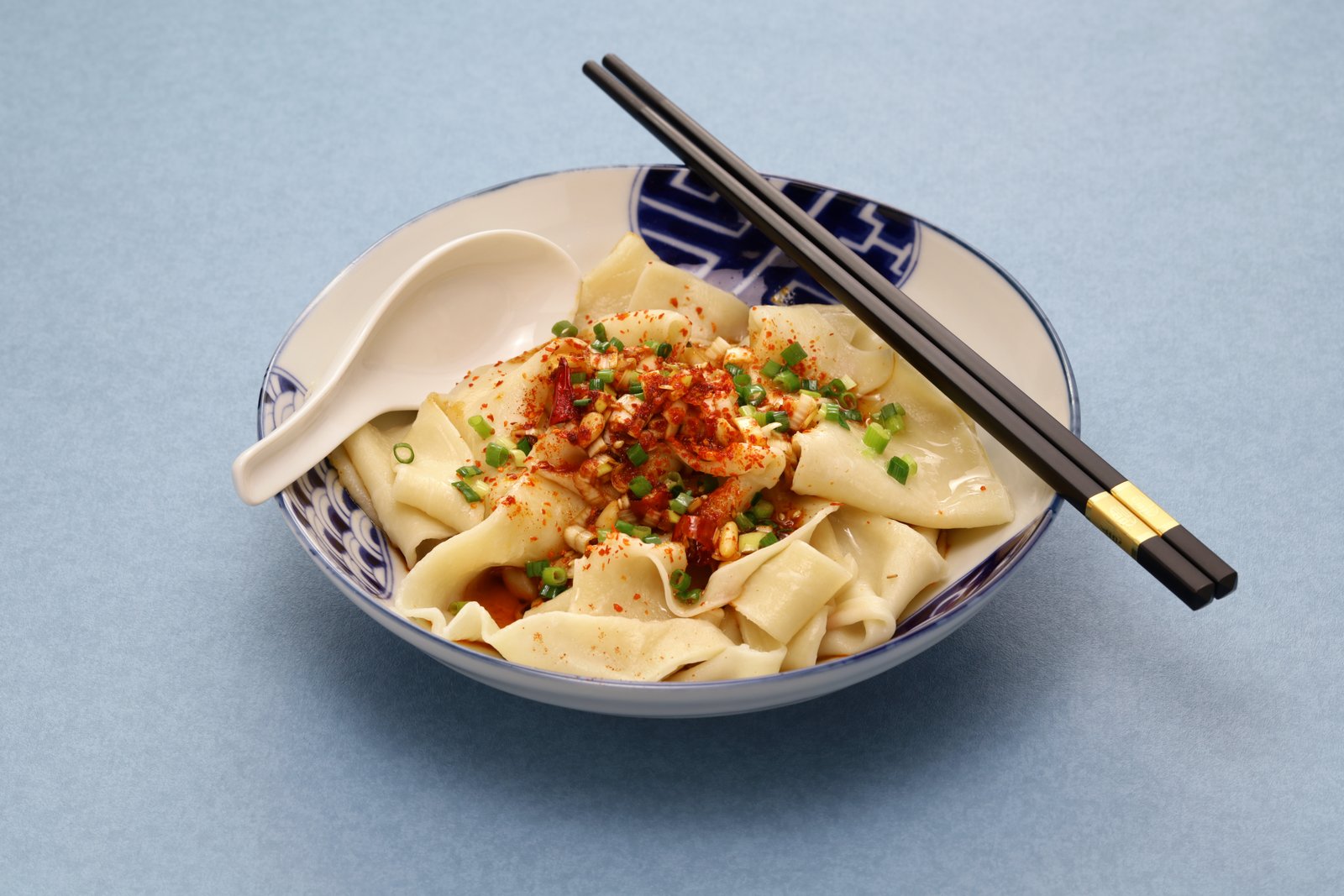
Biangbiang noodles (biángbiáng miàn) are broad, hand-stretched wheat noodles from Shaanxi province, best known in Xi’an. Each strip is pulled long and flat like a belt — locals also call them “belt noodles” — then slapped against the counter as it stretches. That slapping sound, something like biang! biang!, is the most widely repeated explanation for the name. The dish is usually finished simply: garlic, chili flakes, scallions, and a ladle of smoking-hot oil poured over the top.
The name is written with one of the most complex Chinese characters in use today — so complex it long resisted computer encoding. But the noodle technique, the spoken name, and the famous character do not share one securely documented timeline. This page separates what is known from what is legend: what the word means, how to pronounce it, and where the character actually came from.
What Are Biangbiang Noodles?
Strip away the spectacle of the character, and Biangbiang noodles are, at their core, a style of hand-pulled wheat noodle. A ball of dough is stretched, slapped against the work surface, and pulled thinner and wider until it forms one long, thick ribbon — often compared to the width of a belt, which is why it’s also commonly called kuandai mian (裤带面), literally “belt noodle.” The slapping sound the dough makes as it’s stretched — biang, biang — is the usual explanation for the name: an onomatopoeia rather than a word with a meaning of its own. It is not the only account on offer, and the section below sets out another.
Once cooked, the noodles are topped with a hot oil “splash” — chili flakes, garlic, scallions, and often shredded vegetables are piled on top of the noodle, and hot oil is poured directly over the pile, sizzling audibly and releasing the aroma before anything is mixed together. This technique, called you po (油泼, “oil-splashed”), is common across several Shaanxi noodle dishes, not just this one. The result is a noodle that’s chewy and substantial, with a savory, garlicky, mildly spicy finish rather than an aggressively hot one.
What Does “Biang” Mean?
Strictly speaking, biang does not mean anything in standard Mandarin. It is not a standard Mandarin syllable — you will not find it in an ordinary dictionary, and standard input methods cannot type it. It belongs to Shaanxi speech rather than to the standard language, which is part of why its written form is so unusual.
The explanation you will hear most often in Xi’an is that the word is onomatopoeia: the sound of a stretched ribbon of dough being slapped down against the counter, biang! biang!, as the cook works it longer and thinner. This fits what you can watch happening at any noodle stall, and it is the account most widely repeated by cooks themselves.
Other stories circulate. The most popular tells of a penniless scholar who ate a bowl of noodles he could not pay for and invented the character on the spot to settle the bill. It is a good story, and it is repeated on menus across the city, but there is no documentary evidence for it — no early text records the incident, and the character itself does not appear in the historical dictionaries where a genuinely old character would be expected. Treat it as folklore attached to the noodle, not as its history.
There is a third account, and it is a different kind of thing from the other two. It has been proposed, in Chinese writing on the dialects of Guanzhong — the plain around Xi’an — that biang is not a sound-word at all, but a local reading of an ordinary and very common character: 饼 (bǐng), the broad term for a wheat food that supplies the second syllable of shaobing, jianbing and the rest. On that account the dish is 饼饼面, “bing bing noodles,” and what looks like an invented character is a local pronunciation of a plain one.
The case is built from historical phonology rather than from any record of the dish: rhyme pairings in early poetry, and characters used interchangeably in early texts, are marshalled to argue that the sound behind 饼 in this region was once nearer to bang, and that an added glide gives biang. A supporting observation is offered from the ground as well — that in one district on the south side of Xi’an, boiled sheets of dough are still called 水饼子, “water bing.”
We are not in a position to judge that. Assessing a phonological reconstruction is not the same activity as reading a text, and it is not one this page can carry out. We set it beside the slapping-sound story because the slapping-sound story is usually told as though it were the only one, and it is not.
How Do You Pronounce Biangbiang?
Biáng rhymes roughly with the English word “young” preceded by a b — say “byahng,” one syllable, not two. The full dish name is biángbiáng miàn: the first two syllables carry the second (rising) tone, and miàn, meaning noodles, takes the fourth (falling) tone.
A common mistake is to break it into “bi-ang.” It is a single syllable, the same length as bang or bing. Repeating it twice is not emphasis — the doubled form is simply the name, the way the slapping sound comes in pairs.
Because biang falls outside the standard Mandarin syllable inventory, it has no settled spelling in older romanization systems, and you will occasionally see it written byang or bhiang in English sources. Biáng is the form now used almost everywhere.
The Biáng Character: How Many Strokes, and Why the Counts Differ
The character is built inside the walking radical 辶, which wraps around everything else from the left and bottom. Working down what it encloses: 穴, the cave radical, forms the roof. Beneath it, 月 (moon) stands on the left and 刂 (knife) on the right, framing a central block of two rows — 幺 言 幺 (silk, speech, silk) above 長 馬 長 (long, horse, long). 心, the heart, closes the character at the bottom. Nine separate components in all, which is why it is so often described as the most complicated character still in everyday use.
There is no single uncontested handwritten form. Variants rearrange or replace components, and the total also depends on how those components are analyzed, which is why published stroke counts disagree. Fifty-six is widely repeated for one familiar handwritten form. The two forms that Unicode actually encodes are registered more precisely: 58 strokes for the traditional character and 43 for the simplified one. All of these figures can be correct at the same time — they are counting different things, and no single number should be presented as the universal total.
Xi’an has a mnemonic rhyme for assembling all of this, and cooks will recite it if you ask. One widely circulated version runs: a dot flies up to the sky; two bends of the Yellow River; the character 八 opens wide; 言 walks inside; a twist to the left and a twist to the right; a long one left and a long one right; a great horse king in the middle; heart at the foot and moon at the side; leave a hook to hang the malt candy on; then push your cart around Xianyang. The wording varies from shop to shop, which is itself a clue about how the character has been transmitted — by mouth and by trade, not through the classical dictionaries.
The character is often described as impossible to type. That statement is now outdated. Two forms were encoded as U+30EDD and U+30EDE in Unicode 13.0, released in 2020. In principle they can be stored, copied and transmitted as text like any other character.
Practical support remains uneven. Many fonts, keyboards, input methods and devices still cannot display or enter these uncommon characters conveniently. A missing square on a screen therefore indicates a support limitation, not the absence of digital encoding.
The character that follows it in the dish’s name is far more ordinary — but it, too, turns out to mean something other than what most people assume. See the Chinese character for noodles.
Biangbiang, Youpo Mian, and Hand-Pulled Noodles
These three terms are often used as if they were interchangeable. They are not, and the difference is worth getting straight.
Biangbiang names the noodle itself — its shape and how it is made. A single piece of rested dough is stretched by hand into one long, flat, belt-wide ribbon, slapped against the counter as it lengthens. The width is the point; a bowl may hold only a few noodles.
Youpo mian (油泼面, “oil-splashed noodles”) names a finishing method, not a noodle. Chili flakes, garlic and scallion are piled on top of cooked noodles and hot oil is poured over them at the table, cooking the aromatics on contact. Biangbiang noodles are very often served youpo style, which is why the names get conflated — but youpo can be done to other noodles, and biangbiang noodles can be dressed other ways.
Hand-pulled noodles (拉面, lamian) are a different technique altogether: a rope of dough is repeatedly folded and pulled, doubling the number of strands each time, to produce many thin round noodles. Biangbiang noodles are never multiplied this way — they are drawn out from one piece and stay one piece.
You will also see kuandai mian (裤带面, “belt noodles”), which is a descriptive local nickname for the same wide ribbons rather than a separate dish.
Stretching is only one of the two ways China makes a long noodle. The other is to force the dough through a drilled plate, which needs no gluten at all and therefore works with buckwheat, sorghum and starches that cannot be pulled. Those are the pressed noodles of the north, and the method is described in the same sixth-century manual that records the stretched one.
Are Biangbiang Noodles Spicy?
Usually, but not in the way people expect. The standard finish is chili flakes bloomed in hot oil, which gives a warm, fragrant heat rather than a fierce one. Shaanxi cooking uses little or no Sichuan peppercorn, so the tingling, numbing quality of Sichuan food — málà — is absent here. Heat in a bowl of biangbiang noodles is aromatic, not anaesthetic.
Vinegar and raw garlic do as much work as the chili does, and plenty of local versions lean sour rather than hot. At a stall you can simply ask for less chili, or none; the noodles are not built around it.
An Older Technique and a Newer Name
We went looking for the name. Searching the pre-modern Chinese texts we work from — the sixth-century Qimin Yaoshu, the tenth-century Qingyi lu, the Song city memoirs, the Southern dynastic histories, and the encyclopedias that preserve lost works — turns up no entry for biangbiang mian, none for kuandai mian, and none for che mian. The name is not in the record we can check.
The technique is another matter. That is documented, and it runs a long way further back than the name.
The earliest description of the gesture is not a recipe but a poem. Some time in the third century Shu Xi wrote a Fu on Bing, a rhapsody on wheat foods, which survives only where later compilers quoted it. The Song encyclopedia Taiping yulan preserves the working passage:
於是火盛汤涌,猛气蒸作,攘衣振服,握搦拊搏,面弥离於指端,手萦回而交错,纷纷馺馺,星分雹落。
“Then the fire is high and the water boils and the steam drives up; sleeves are pushed back and clothes shaken out; there is gripping and slapping; the dough spreads away from the fingertips and the hands wind back and forth across each other; down it comes, scattering like stars, like hail.”
The vocabulary is compressed and some of it is obscure. The action is not. Someone was standing next to a cook, watching hands work dough out thin and throw it into boiling water, and wrote down what that looked like.
Three centuries later the method itself is written down. The Qimin Yaoshu records a noodle it calls 水引, “water-drawn”:
水引:挼如箸大,一尺一断,盘中盛水浸。宜以手临铛上,挼令薄如韭叶,逐沸煮。
“Shuiyin: work it until it is as thick as a chopstick, break it into one-foot lengths, and steep them in a dish of water. Then, holding it over the pot, work it out until it is as thin as a chive leaf, and boil it as the water rises.”
What none of these passages gives is width. 薄如韭叶 — thin as a chive leaf — is a narrow noodle. A third notice, the Shi xi quoted in the same encyclopedia, reaches for a different figure and says the same thing: 细如委綖,白如秋练, “fine as a hanging cap-cord, white as autumn silk.” The gesture behind a bowl of biangbiang noodles is very old. The belt is not documented with it, and neither is the name.
We also know who was eating it. The Nan Qi shu, the official history of the Southern Qi, has a court official named He Ji entertaining the man who would shortly become emperor:
太祖为领军,与戢来往,数置欢宴。上好水引饼,戢令妇女躬自执事以设上焉。
“When Taizu was Commander of the Army he used to call on Ji, and they held feasts more than once. His Majesty was fond of shuiyin bing, so Ji had the women of his household make them with their own hands and set them before him.”
The later Nan shi tells the same story and names the guest outright — 高帝好水引饼,戢每设上焉, “Gaodi was fond of shuiyin bing, and Ji set them before him every time.” Xiao Daocheng was not yet Emperor Gao of Qi when this happened; he was a general who liked calling round for the noodles. So in the fifth century this was neither palace cookery nor street food. It was something the women of a well-off household made by hand, and good enough to put in front of a man you were trying to impress.
The oil is older than the chili, too. A tenth-century collection, the Qingyi lu, gives a dressing under the heading 胡麻自然汁, “the natural juice of sesame”:
羹虀寸截连汁置洁器中,炼胡麻自然汁投之,更入白盐,捣姜搅匀,泼淡汤饼。此乃余杭寿禅师法。非事佛者,加炼熟葱韭益佳。
“Cut the soused greens into inch lengths and set them, with their liquor, in a clean vessel. Pour in rendered sesame oil, add white salt and pounded ginger, stir until even, and splash it over plain noodles. This is the method of Chan Master Shou of Yuhang. Those not keeping the Buddhist rule may add rendered scallion and chives, which is better still.”
泼, the verb there, is the one in you po. What is absent is the chili: capsicum did not reach China until the late Ming, so the ingredient an English reader reaches for first as the defining one could not have been in that bowl. And the method is a monk’s, from Yuhang near Hangzhou, not from Shaanxi. Splashing a seasoned oil over plain noodles is a thousand years old and was never a regional secret. The particular seasoning is neither.
Older food records from Shaanxi, meanwhile, do not provide a securely dated entry for a noodle called biangbiang mian. One name that is repeated is you po zhu tou mian (油泼箸头面), an oil-splashed hand-pulled noodle connected with the Qing period and an older name, xiang gun mian (香棍面). That supports a Shaanxi tradition of stretching wheat dough and finishing noodles with hot oil. It does not establish that the earlier noodles had the same belt-like width, the biangbiang name, or the complex character. The phrase zhu tou, “chopstick head,” may even point the other way — and 箸, chopstick, is exactly the unit the sixth-century manual reaches for when it wants to fix a noodle’s thickness.
Two timelines therefore need to be kept separate. The craft behind the noodles belongs to an established Shaanxi wheat-food tradition. The biangbiang name and its elaborate written forms are much harder to trace in older records and appear to have gained prominence more recently.
How Biangbiang Noodles Are Served
Biangbiang noodles are commonly served as long wheat ribbons with chili, garlic, scallions, and other seasonings arranged on top. Hot oil is poured over the aromatics before the noodles are mixed.
The exact toppings, vessel, noodle width, and heat level vary by cook and setting. The defining relationship is between the broad, hand-stretched dough and the seasonings that coat it, not a single fixed restaurant presentation.
Frequently Asked Questions
Can I actually type the biáng character?
In principle, yes. Two forms were encoded in Unicode 13.0 as U+30EDD and U+30EDE, so the character can be stored and copied like any other text. Whether it displays or can be entered directly still depends on your font, input method, operating system and device — an empty box on screen means missing font support, not missing encoding.
How do you write “biangbiang noodles” in Chinese?
The full dish name is 𰻞𰻞面 in simplified Chinese and 𰻞𰻞麵 in traditional — the biáng character written twice, followed by the character for noodles. If those first two characters appear as empty boxes on your screen, your font does not cover the Unicode block they live in.
What are the wide, flat Chinese noodles called?
In Xi’an they are biangbiang noodles, known locally as kuandai mian (裤带面), literally “belt noodles,” after their width. Each one is stretched by hand from a single piece of dough, so a bowl may hold only a few noodles.
Sources
Taiping yulan 太平御览, compiled by Li Fang 李昉 and others, Northern Song — juan 860, quoting Shu Xi 束皙, Fu on Bing 饼赋 (third century), and the Shi xi 食檄. Both survive only in quotation; the readings here are those of the Taiping yulan text.
Qimin Yaoshu 齐民要术, Jia Sixie 贾思勰, Northern Wei (sixth century) — chapter 饼法第八十二, section 82.10, on 水引.
Nan Qi shu 南齐书, Xiao Zixian 萧子显, Liang dynasty — juan 32, liezhuan 13, the biography of He Ji 何戢.
Nan shi 南史, Li Yanshou 李延寿, Tang dynasty — juan 30, liezhuan 20, the biography of He Ji 何戢.
Qingyi lu 清异录, attributed to Tao Gu 陶穀, tenth century — the entry 胡麻自然汁.
A note on what is and is not sourced here. The passages above are quoted from the texts named. The Qing-period dating of you po zhu tou mian, and the older name xiang gun mian, are repeated from modern regional food writing, which itself gives them as 相传 — “it is handed down” — rather than as a dated record; we have not found either name in any pre-modern text we can check. The proposal that biang is a local reading of 饼 is likewise a modern philological argument rather than something recorded in an early text, and we describe it above without endorsing it. The scholar who invented the character to settle his bill has no documentary source at all.
Related Xi’an Food Histories
Biangbiang noodles belong to Xi’an’s wider wheat-food tradition. The Xi’an street food guide explains that broader setting. For contrasting forms, compare their stretched wheat ribbons with the cold steamed sheets of liang pi and the hand-torn bread used in yang rou pao mo.