Wontons have been sold under that name in Chinese cities for more than a thousand years, and nobody has ever satisfactorily explained what the name means. That second half is not a gap in the English-language record. It is a gap in the Chinese one, and writers in China have been pointing at it for a long time.
What a wonton is
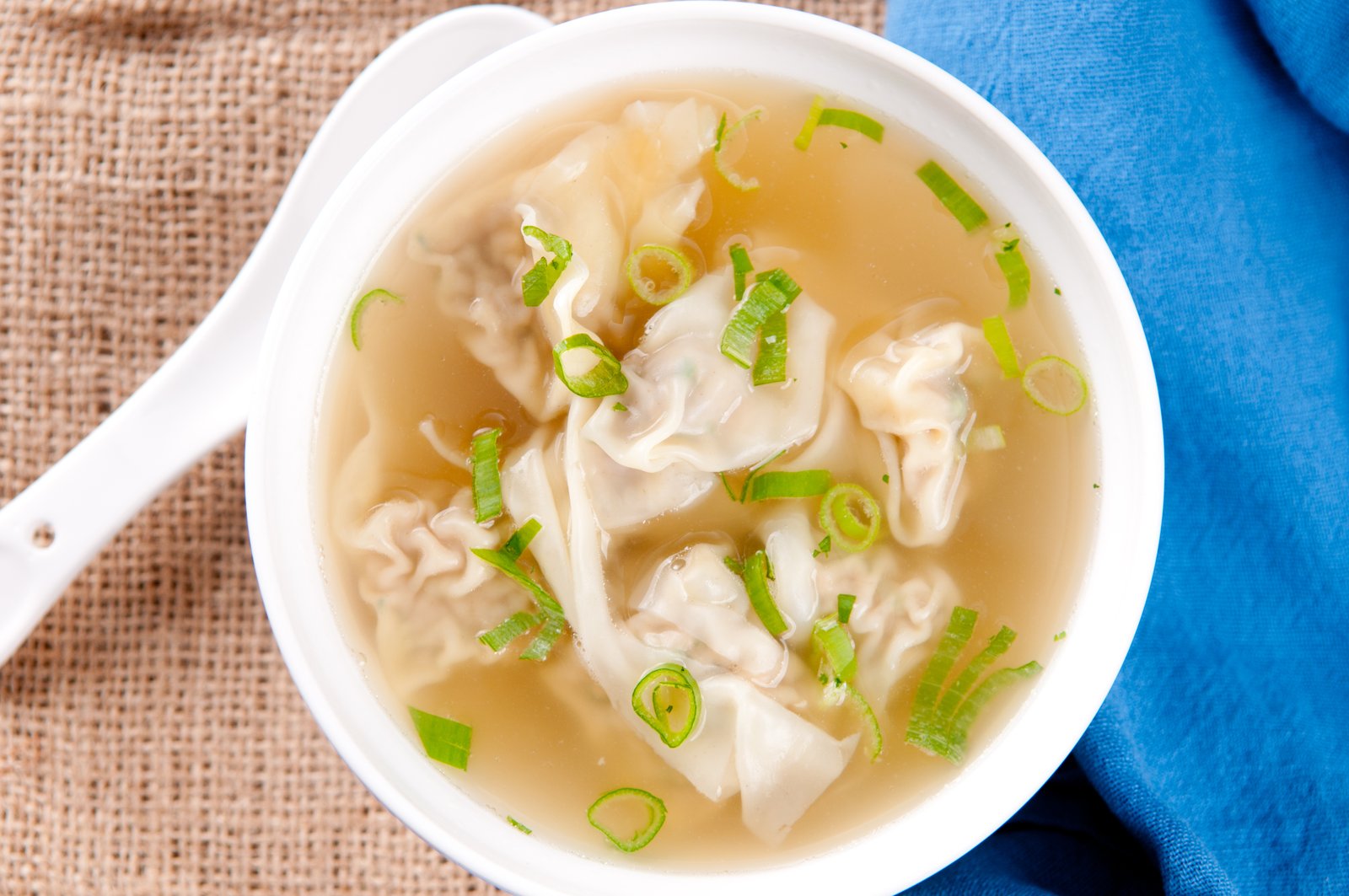
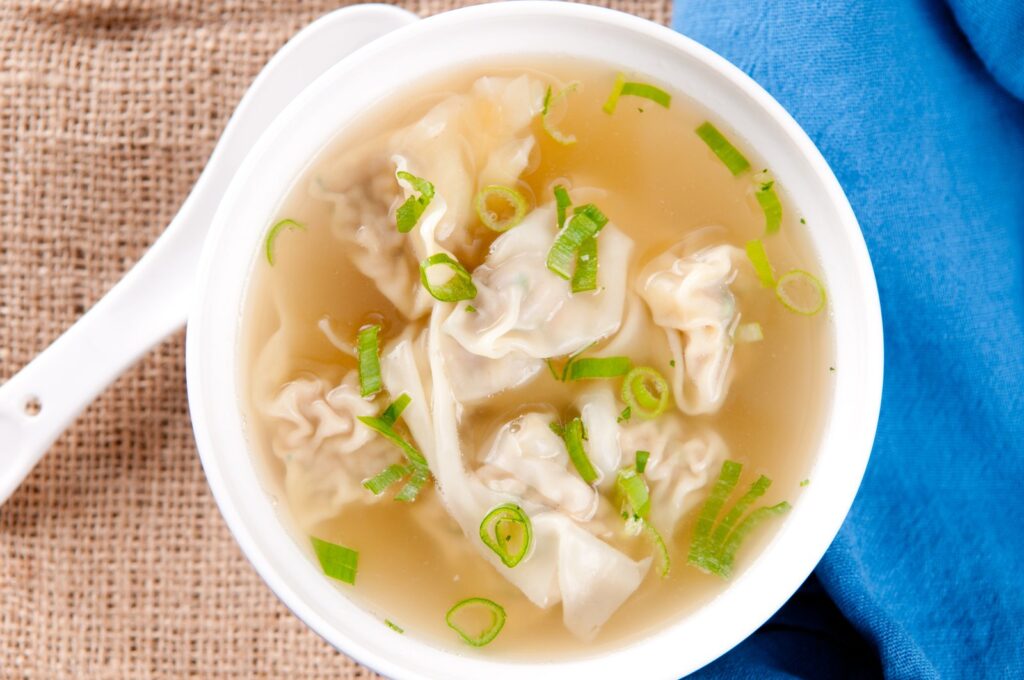
A wonton is a very thin sheet of wheat dough folded around a small amount of filling and dropped into broth. The wrapper is the thing you notice: thin enough to go translucent where there is no filling behind it, so the cooked parcel trails a loose skirt of dough through the soup. In Mandarin the word is written 馄饨 and pronounced huntun.
The filling is usually pork, sometimes pork and shrimp, and there is usually not very much of it. That last point sounds like a criticism. It is not, and the rest of this page is largely about why.
Other parts of China have their own words for the same kind of parcel, and Sichuan’s chaoshou is the one an American menu is most likely to show.
The name is older than any explanation of it
If you look up where the English word comes from, you will find a tidy answer involving clouds. It is a pleasant story and it is repeated almost everywhere.
What you will not find is any equivalent agreement on the Chinese side. The best-known Chinese explanation is that the word preserves two surnames. In 1906 a Beijing writer, Fucha Dunchong, set that explanation down in his record of the capital’s seasons — and then rejected it:
又《演繁露》:世言馄饨是塞外浑氏屯氏为之。言殊穿凿。
The last three characters mean, roughly, that the account is forced. He then gave his reason, and the reason is a good one:
若如《演繁露》二氏为之之言,则何者为馄何者为饨耶?是亦胶柱鼓瑟矣。
If two men named Hun and Tun invented it, he asks, then which of the two syllables is which man? He is doing to a folk etymology exactly what a careful reader would do to it today: testing whether the story can carry the word it claims to explain.
Fucha Dunchong then offered a different explanation of his own, involving the shape of the thing and an older word for undifferentiated chaos. That one is a guess too, and it is worth saying plainly that he replaced one unproven account with another.
Writing decades later in Taipei, the essayist Liang Shiqiu opened his piece on fried wontons by reaching for the same Song-dynasty source and reaching the same verdict:
馄饨这个名称好古怪。
“The name is very strange,” he begins — and after quoting the surname story, he adds 未必可信, it is not necessarily to be believed.
The two men quote that source differently. One has 塞外浑氏屯氏, the other has 虏中挥沌氏. The sentence they are both rejecting had already changed shape in transmission before either of them got to it.
English has one tidy answer. Chinese has two signed refusals.
The oldest praise is for the broth
In the ninth century, Duan Chengshi listed the dishes that the well-off households of the capital were known for. The list is short and every entry names the thing that made that household famous:
今衣冠家名食有:萧家馄饨,漉去汤肥,可以瀹茗。庾家粽子,白莹如玉。
The Yu family’s zongzi are remembered for how they look — white and bright as jade. Another household is remembered for a technique, another for the cuts of meat it could handle. The Xiao family’s wontons are remembered for something else entirely: skim the fat off the broth, the entry says, and you can brew tea with it.
That is the only item on the list praised for what is left in the bowl rather than for the food itself.
A century or so later, a note on the city of Jinling collected seven local points of pride, and one of them is the same idea pushed further:
金陵士大夫渊薮,家家事鼎铛,有七妙:虀可照面,馄饨汤可注砚,饼可映字……
Wonton broth clear enough to pour into an inkstone and grind ink with. Two writers, a century and several hundred miles apart, both chose to praise this food by describing what its liquid could be used for afterward.
English shelves the wonton under dumpling, a word that classifies by what is inside. Neither of these records classifies it that way.
A Song recipe spends almost all its words on the wrapper
A Song household manual gives a method. It is four lines long, and it is worth counting where the attention goes:
白面一斤、盐三钱和,如落索面,更频入水搜,和为饼剂。少顷,操百遍,捯为小块,捍开,绿豆粉为粋,四边要薄,入馅,其皮坚。
A pound of flour and three qian of salt. Work the dough a hundred times. Break it into small pieces and roll them out. Dust with mung bean flour so they do not stick. The four edges must be thin. The skin will hold.
The filling gets two characters: 入馅, add filling. That is the entire instruction.
The same emphasis survives into living memory. Liang Shiqiu, writing decades after he had left Beijing, described the wonton peddler’s carrying pole of his childhood — the shout of 馄饨——开锅, the bone broth that had been going long enough to turn cloudy, and then the parcels themselves:
馄饨的皮子薄,馅极少,勉强可以吃出其中有一点点肉。
Very little filling; you can just about taste that there is a bit of meat in there. He then lists the seasonings, and the list is long: scallion, cilantro, dried shrimp, preserved vegetable, soy sauce, vinegar, sesame oil, and black pepper shaken out of a length of bamboo.
Tang Lusun, recalling the same city in the same years, counted it the same way — one wonton got a smear of pork, and the bowl got seaweed, preserved vegetable, dried shrimp and pepper. He also recorded something smaller and harder to argue with. Everywhere else, he wrote, people say they are going to eat a bowl of wontons. In Beijing’s big-jar wine shops they said they were going to drink one.
In one Tang book, it is not food at all
A Tang dietary manual, compiled by Meng Shen and later expanded, lists foods and plants by what they treat. Under mugwort:
若患冷气,取熟艾面裹作馄饨,可大如弹许。
Wrap processed mugwort in dough to make a wonton, about the size of a pellet. The word is being used here for a dose.
Under Sichuan pepper, the same book goes further:
伤损成疮、中风,以面裹作馄饨,灰中炮之,使熟断开口,封其疮上,冷易热者,三、五度易之。
Wrap the pepper in dough to make a wonton. Roast it in the embers. When it is done, break it open and press it against the wound. When it cools, swap it for a hot one; do this three or five times.
Nothing in that passage is eaten. In a book from more than a thousand years ago, the word names a small dough-wrapped object that goes on a sore.
One tray, and twenty-four different kinds in it
When the Tang court showered gifts on the general An Lushan, the inventory of what he received ran to lacquerware, textiles, weapons and tableware. One line is a serving tray:
金银平脱隔馄饨盘
A wonton tray with divisions in it, made in an elaborate gold-and-silver lacquer technique. The tray is compartmented, which means what was being served on it was not all the same.
A menu from a banquet given by the official Wei Juyuan, recorded in a later collection of curiosities, says so directly. Among the dishes:
生进二十四气馄饨 花形馅料各异,凡二十四种
Twenty-four wontons, one for each solar term of the year, each with a different shape and a different filling.
Centuries later, in Hangzhou, the habit had not gone away. A record of the Southern Song capital notes that wealthy households competed at it, and that a single vessel might hold more than ten varieties, which people called 百味馄饨 — hundred-flavor wontons.
Three records, spread across five hundred years, all describing the same idea: one serving, many kinds, no two alike. A takeout carton holds a dozen of the same thing.
One of those twenty-four solar terms is the winter solstice, which is where this food turns up next.
By 1758 the proverb and the food had come apart
By the Song dynasty, wontons were at every level of the city at once. A guide to Hangzhou’s morning market lists a stall by name — 六部前丁香馄饨,此味精细尤佳, the Clove Wonton stall in front of the ministries, unusually fine. In the same century and the same city, a gentleman’s private calendar of seasonal pleasures scheduled eating wontons in a named pavilion of his garden, in the eleventh month, between viewing wintersweet and melting snow to brew tea with.
That same record of Hangzhou notes what the households of the capital offered to their ancestors at the winter solstice: 享先则以馄饨.
The association held for centuries. A Beijing almanac of 1758 gives the proverb in its entry for the summer solstice:
谚云:”冬至馄饨夏至面。”
Wontons at the winter solstice, noodles at the summer one. But turn to that same book’s entry for the winter solstice itself, and look at what was actually set out:
预日为冬夜,祀祖羹饭之外,以细肉馅包角儿奉献。谚所谓”冬至馄饨夏至面”之遗意也。
What went on the table was 包角儿 — parcels of finely chopped meat folded to a point. Not wontons. And the author knows it: he writes that this is the 遗意 of the proverb, the sense left over from it.
That is a writer in 1758 recording, in his own hand, that the name and the thing had come apart, and that people were carrying the name forward anyway.
By 1906, Fucha Dunchong was describing a solstice with the food back in place and the festival mostly drained out of it: 民间不为节,惟食馄饨而已 — ordinary people do not keep it as a holiday, they just eat wontons.
The proverb kept its place long after the thing on the table had changed, and then the thing changed back. In 2026 the winter solstice falls on December 21.
Frequently Asked Questions
What does wonton actually mean?
There is no settled answer, and that is not an English-language problem. The best-known Chinese explanation — that the two syllables preserve two surnames — was rejected in print in 1906 on the grounds that it cannot say which syllable belongs to which man, and rejected again decades later by an essayist who called the name “very strange.” What can be said is that the word is old, and that in the earliest records we have read it is already attached to a dough-wrapped parcel.
Is it spelled wonton, won ton, or wanton?
All three turn up, and the first two are the same word: wonton is the ordinary modern spelling, and won ton is a spacing variant that still appears on menus. Wanton is a different English word entirely, meaning reckless or unrestrained, and it has nothing to do with food. A menu offering “wanton soup” is a misspelling, though a common one.
Are wontons a type of dumpling?
In English, yes — dumpling is a broad category and wontons sit inside it. But the English category sorts by what is inside, and the Chinese records sort by something else. A ninth-century list praises one household’s wontons for the broth they leave behind. A Song recipe spends four lines on the dough and two characters on the filling. Calling a wonton a dumpling is not wrong; it just files it under the one feature the old records paid least attention to.
Are wontons and crab rangoon the same thing?
No. Crab rangoon is an American dish that happens to use wonton wrappers. It reverses the two things the records above keep insisting on: the filling is the point, and there is no broth at all. We have no historical sources on how crab rangoon came about, so this page will not guess, but the contrast is a useful way to see what the older records were actually describing.
Which country are wontons from?
The records we have read are Chinese, and they are early: a ninth-century list of famous households in the Tang capital, a Tang dietary manual, and a run of Song-dynasty guides to Kaifeng and Hangzhou that treat wontons as an ordinary part of city life. That is what our sources show. We have not surveyed the food histories of other countries, so we are not in a position to say what does or does not appear in them.
Is wonton a Cantonese or a Mandarin word?
The English spelling follows the Cantonese pronunciation; the Mandarin reading of the same characters is huntun. The regional names for this food, and how the English word arrived at its current shape, are covered on our page about chaoshou in chili oil.
Are wontons always pork?
No, though pork is the modern default. The Tang banquet menu mentioned above lists twenty-four wontons with twenty-four different fillings. The Tang dietary manual wraps mugwort in one and Sichuan pepper in another, neither of them meat and neither of them eaten as a meal. Shrimp, chicken and vegetable versions are all ordinary today.
When do Chinese people eat wontons?
Year round, as breakfast and as a snack. But the winter solstice association is old and durable: a Song record of Hangzhou notes that households offered wontons to their ancestors on that day, an eighteenth-century Beijing almanac quotes the proverb “wontons at the winter solstice, noodles at the summer one,” and a Beijing writer in 1906 reported that ordinary people no longer treated the day as a holiday and simply ate wontons. The 2026 winter solstice falls on December 21.
What is the difference between a wonton and a potsticker?
A potsticker is pan-fried and eaten dry with a dipping sauce; a wonton is nearly always boiled and served in broth, and its wrapper is much thinner. The wrapper thickness follows from the cooking method — a potsticker’s skin has to survive the pan.
Sources
Meng Shen 孟诜, Shiliao bencao 食疗本草 (Tang), entries “Ai ye” 艾叶 and “Shu jiao” 蜀椒.
Duan Chengshi 段成式, Youyang zazu 酉阳杂俎 (9th c.), 1.18 and 7.18.
Tao Gu 陶谷, Qingyi lu 清异录 (10th c.), “Jiankang qi miao” 建康七妙 and the Wei Juyuan banquet account.
Wu shi zhongkui lu 吴氏中馈录 (Song), “Huntun fang” 馄饨方.
Meng Yuanlao 孟元老, Dongjing meng hua lu 东京梦华录 (12th c.), juan 4.
Wu Zimu 吴自牧, Menglianglu 梦粱录 (Southern Song), morning market.
Zhou Mi 周密, Wulin jiushi 武林旧事 (13th c.), juan 3 “Dongzhi” 冬至 and juan 10.
Pan Rongbi 潘荣陛, Dijing suishi jisheng 帝京岁时纪胜 (1758), entries for the summer solstice and the eleventh month.
Fucha Dunchong 富察敦崇, Yanjing suishi ji 燕京岁时记 (1906), “Dongzhi” 冬至.
Liang Shiqiu 梁实秋, “Jian huntun” 煎馄饨, written decades after he left Beijing.
Tang Lusun 唐鲁孙, recollections of Beijing written decades after he left it.