Two Chinese words, one English phrase. Search for either tangyuan or yuanxiao and you get “glutinous rice balls”, which is accurate and tells you nothing, because the two words do not name the same thing.
The short answer is the one most explanations give, and it is right: tangyuan are wrapped, yuanxiao are rolled. But there are two further differences that usually get left out, and they are the more interesting ones. One of these foods is eaten all year and the other appears for about a month.
What they are
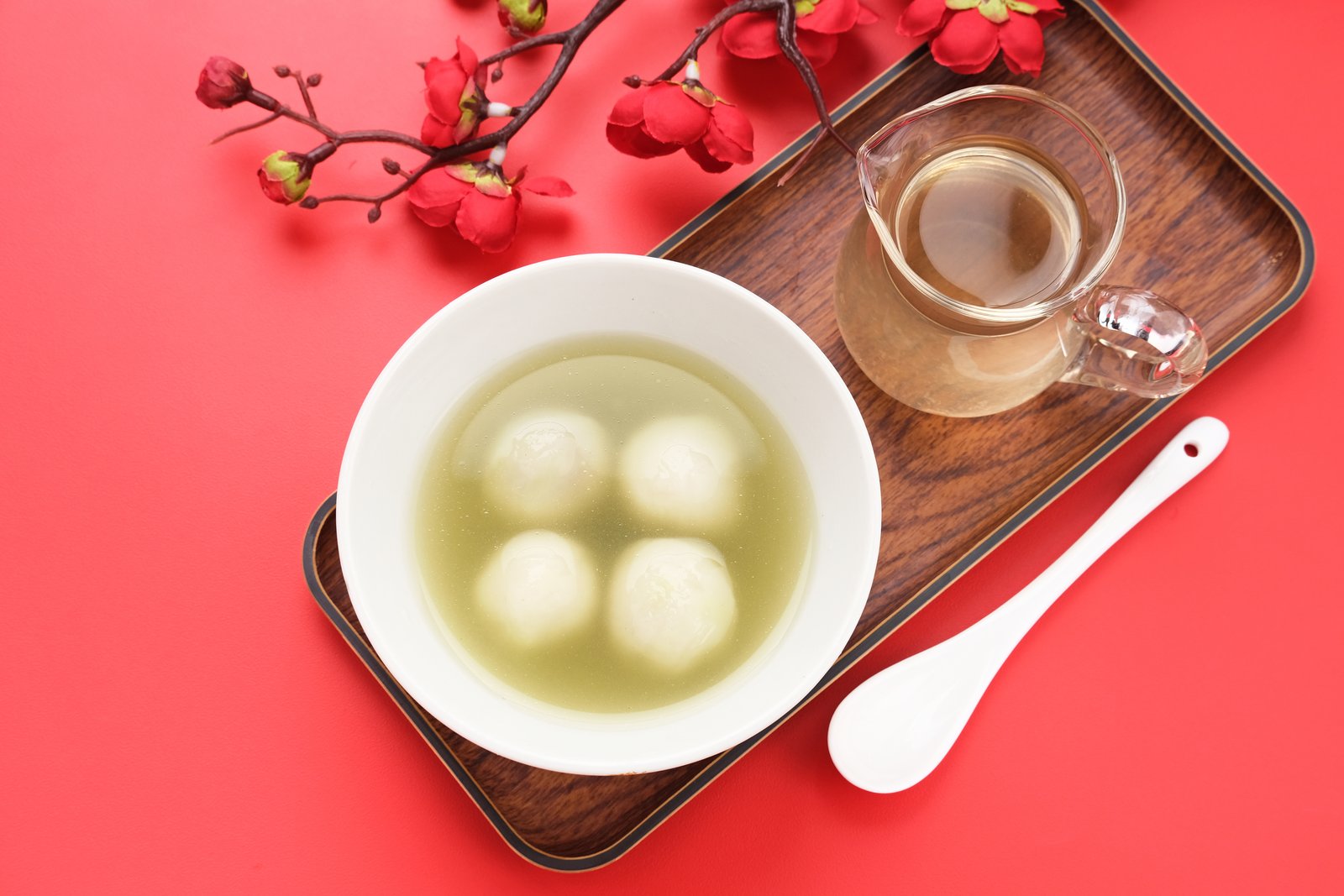
Balls of glutinous rice flour, usually with a sweet filling, boiled and served in the water they cooked in. The skin is soft and stretchy and slightly slippery; the filling is a dense paste. Black sesame is the classic; red bean and peanut are common too. Southern versions also come savory, with pork.
They are eaten hot, from a bowl, with a spoon, usually a few at a time in a thin sweet soup. Fermented rice wine is a common base for that soup in parts of the south, which is why they turn up inside other dishes rather than only on their own.
Sizes vary from about a thumbnail to a walnut. The very small ones are usually unfilled, and are treated as an ingredient rather than a dish.
Wrapped or rolled
This is the difference that matters, and it is a difference in manufacture, not in recipe.
To make tangyuan you work the glutinous rice flour into a dough with water, take a piece, flatten it in your palm, put the filling in, close it and roll it round between your hands. It is the same motion as making a small filled bun. Tang Lusun, a Beijing-born writer recalling the city of his childhood decades later, describes it exactly that way: 先擀好了皮儿,放上馅儿然后包起来搓圆 — roll out a skin first, put the filling on, then wrap it up and roll it round.
To make yuanxiao you start from the other end. The filling is made first, set firm, and cut into cubes. The cubes are damped and tipped into a flat basket of dry glutinous rice flour, and the basket is shaken so they roll and pick up a coat. Then they are damped again and shaken again. The skin is built up in layers, like a snowball, and it is never wrapped around anything.
Tang Lusun’s summary of the two is the cleanest we have seen: 北方叫摇元宵,南方叫包元宵 — in the north you say “shake yuanxiao”, in the south you say “wrap yuanxiao”. The verb is the name of the process.
The consequences are practical. Rolled skins are thicker and less even, they absorb more water, and they cloud the soup. Wrapped skins are thinner and smoother, and the soup stays clearer.
This split is not new. In a Beijing guide of 1758 the two methods are already set against each other in a single line, in a passage listing the capital’s notable tradesmen by name:
孙胡子,扁食包细馅;马思远,糯米滚元宵。
Sun the Beard, dumplings wrapped round a fine filling;
Ma Siyuan, yuanxiao rolled in glutinous rice flour.
Two shops, two verbs. 包 for the dumpling and 滚 for the yuanxiao, in the same breath, more than two and a half centuries ago. Whatever else has changed, the motion has not.
Only one of them is eaten all year
The second difference is about when, and it is the one most English pages skip.
Tangyuan are not tied to a single date. In much of the south they are eaten at the winter solstice, at New Year, at the Lantern Festival, and at weddings and births, and in some places the New Year’s Eve bowl is tangyuan rather than the dumplings a lot of English writing treats as universal. They are also simply sold, all year, as something to eat.
Yuanxiao are not like that. Tang Lusun is blunt about the north he grew up in: 在北方,正月家家饽饽铺都有元宵卖,正月一过,想吃元宵要等来年了 — in the north every pastry shop sells yuanxiao through the first month, and once the first month is over, if you want yuanxiao you wait until next year. In the south, he says, you can eat them at the start of winter, at the solstice and at the Lantern Festival alike.
The Qing records line up with that. The 1758 guide files yuanxiao among the foods of the first month. The 1906 record of the Beijing year puts them under the lantern days: 市卖食物,干鲜俱备,而以元宵为大宗 — of the food sold in the market, fresh and dried alike, yuanxiao are the biggest trade. Both entries are seasonal entries. Neither treats yuanxiao as something you would find in June.
So the two names differ on three axes at once — how they are made, where, and when. Which raises the question of why the northern one should be locked to a single fortnight in a way the southern one is not.
The older name is not a food name at all
元宵 yuanxiao means the first full-moon night of the year. It is the name of the night, and of the festival held on it. The food is called after the occasion.
You can watch that happen in the records, because there is a period when it has not happened yet.
Wu Zimu’s account of Hangzhou under the Southern Song lists the city’s snack trades in detail. In the section on the shops selling cooked snacks, there is this:
又有粉食店,专卖山药元子、真珠元子、金橘水团、澄粉水团……
There are also flour-food shops, selling yam yuanzi, pearl yuanzi,
kumquat shuituan, clear-flour shuituan…
And then, a few lines on, the things hawked in the street:
及沿街巷陌盘卖点心:……春饼、芥饼、元子、汤团、水团、蒸糍、栗粽……
And sold from trays through the streets and lanes: …spring pancakes,
mustard cakes, yuanzi, tangtuan, shuituan, steamed glutinous cakes,
chestnut zongzi…
Three names side by side on one street list: 元子, 汤团, 水团. Things are listed separately because they are separate; and none of the three is called yuanxiao.
Meanwhile the same book does have an entry headed 元宵. It runs to several hundred characters on lantern hills and colored silk, water pouring from the fingers of figures on a scaffold, a dragon made of straw with ten thousand lamps inside it, and the city government’s subsidies for the occasion. It does not mention anything to eat.
By 1758 in Beijing the picture has changed: yuanxiao appears in a list of seasonal foods of the first month, alongside pepper trays, cypress wine and spring pancakes. The night’s name has attached itself to a food.
The southern names did not make that move. 汤团 tangtuan — soup ball — survives as 汤圆 tangyuan, which describes the thing in the bowl and commits to no date at all. That, as far as the records let us see, is the reason the two behave differently: a food named after a festival is hard to sell in June, and a food named after a bowl of hot water is not.
⚠️ That last sentence is our reading of the sources, not a statement any of them makes. The records show the sequence; the explanation is ours.
The year the word was banned
There is a story attached to the name, and it is worth telling with its caveats attached.
Tang Lusun recorded that when Yuan Shikai declared himself emperor at the end of 1915, his officials had Beijing’s pastry shops ordered to stop saying yuanxiao and say tangtuan instead — because 元宵 sounds like 袁消, “Yuan is finished”. The shops complied. One did not: Zhengmingzhai on Qianmen Street, the best-known yuanxiao seller in the city, put out its usual New Year signboards, forgot to change the wording, was reported, and was fined a hundred silver dollars for defying the order. When the monarchy collapsed a few months later, the shop built a decorated arch outside its door and spelled out 各式元宵— “yuanxiao, all kinds” — in small electric bulbs.
We have not found a contemporary newspaper or official record of the order, and we have not searched everywhere. Tang Lusun was eight years old in 1916 and writing decades afterwards, so this is something he heard and remembered rather than something he witnessed, and a story this well furnished has usually been told a good many times. Treat it as what it is: a thing a Beijing writer set down about his own city.
It belongs here anyway, because whatever its accuracy it is a story about this exact problem. A name can be taken away by decree, and put back with light bulbs.
Not a dumpling, and not mochi
Two comparisons come up constantly, and both are close enough to be worth answering properly.
Dumplings. English uses “dumpling” for almost anything small, filled and boiled, which is how tangyuan end up on dumpling lists. But the Chinese categories do not work that way: 饺子, 包子 and 汤圆 belong to different families, made from different flours by different methods, and no Chinese menu groups them together. The 1758 couplet quoted above puts a dumpling shop and a yuanxiao shop side by side precisely as a contrast. If you want the longer version of that argument, it is on the page about baozi.
Mochi. Closer, and the confusion is reasonable. Both are glutinous rice, both are chewy, and mochi ice cream has made the texture familiar. The difference is the starting material and the work done to it. Mochi is made from steamed glutinous rice pounded into a mass. Tangyuan are made from glutinous rice flour mixed with water into a dough. Pounded rice and rice flour behave differently: mochi is denser and more elastic, tangyuan skin is softer and gives way sooner. Mochi is usually eaten cold or at room temperature and tangyuan are eaten hot, in liquid, which changes everything about how they feel.
Dango, songpyeon and other round rice sweets across the region raise the same question and get the same answer: the shape is common because the method is simple, and the shape is not the relationship.
Frequently Asked Questions
What is the difference between tangyuan and yuanxiao?
Tangyuan are wrapped: a skin of glutinous rice dough is flattened, filled and rolled closed. Yuanxiao are rolled: cubes of firm filling are shaken in a basket of dry glutinous rice flour, damped, and shaken again, building the skin up in layers. Tangyuan are a southern name and are eaten all year; yuanxiao are a northern name and appear mainly in the first lunar month.
Is tangyuan the same as mochi?
No. Mochi is steamed glutinous rice pounded into a mass; tangyuan are made from glutinous rice flour worked into a dough with water. Mochi is denser and chewier and usually eaten cool. Tangyuan are softer and eaten hot in soup.
Are tangyuan dumplings?
Not in the Chinese sense. English “dumpling” covers a much wider range than any Chinese term does. 汤圆 is a rice-flour food in its own category, separate from the wheat-flour families that 饺子 and 包子 belong to.
What does tangyuan mean in English?
Roughly “soup round” or “soup ball” — 汤 is soup, 圆 is round. The older form 汤团 tangtuan means the same. Neither name mentions rice or filling; both describe the thing in the bowl.
When are tangyuan eaten?
At the Lantern Festival, which falls on the fifteenth day of the first lunar month — 20 February in 2027. But in much of southern China they are also eaten at the winter solstice, at New Year, at weddings, and simply as a snack at any time of year. Yuanxiao, the northern rolled kind, are the ones largely confined to the festival season.
Why are tangyuan eaten at Chinese New Year?
Because the round shape and the name are read as a wish for family wholeness, and because in parts of the south they are the New Year’s Eve bowl in place of dumplings. The association is with roundness and reunion rather than with any one legend.
Are tangyuan vegetarian or vegan?
The common sweet fillings — black sesame, red bean, peanut — usually are, but lard is used in some traditional sesame fillings and savory tangyuan are made with pork. Check the packet or ask. This is a description of what is usually in them, not a ruling.
Is it spelled tangyuan or tang yuan?
Both are used. “Tangyuan” as one word is the more common form in English writing and is what we use here; “tang yuan” follows the two Chinese syllables. The Chinese is 汤圆 either way.
How do you pronounce tangyuan?
Roughly tahng-ywen. In Mandarin it is tāng-yuán, with the second syllable close to the English word “yuan”. The first rhymes with “song”, not with the English word “tang”.
SOURCES
Wu Zimu 吴自牧, Meng liang lu 梦梁录, Southern Song — 荤素从食店(诸色点心事件附); 元宵. Text as printed in the modern simplified-character edition we used.
Pan Rongbi 潘荣陛, Dijing suishi jisheng 帝京岁时纪胜 (1758) — 正月·时品 (yuanxiao among the seasonal foods of the first month); 十二月·皇都品汇 (the couplet on Sun the Beard and Ma Siyuan). Text as printed in the Beijing Guji Chubanshe edition.
Fucha Dunchong 富察敦崇, Yanjing suishi ji 燕京岁时记 (1906), the lantern days. Text as printed in the Beijing Guji Chubanshe edition.
Tang Lusun 唐鲁孙, “Beiping de bobo pu” 北平的饽饽铺. A recollection of Beijing written decades after the fact.