Rou jia mo (肉夹馍) is a Shaanxi street food: chopped, slow-braised pork packed into a round griddle-baked wheat bun. It is sold from Xi’an breakfast stalls and street windows, eaten in the hand, and usually finished in under two minutes.
That is the dish. The interesting part is the name, which appears to describe something else entirely.
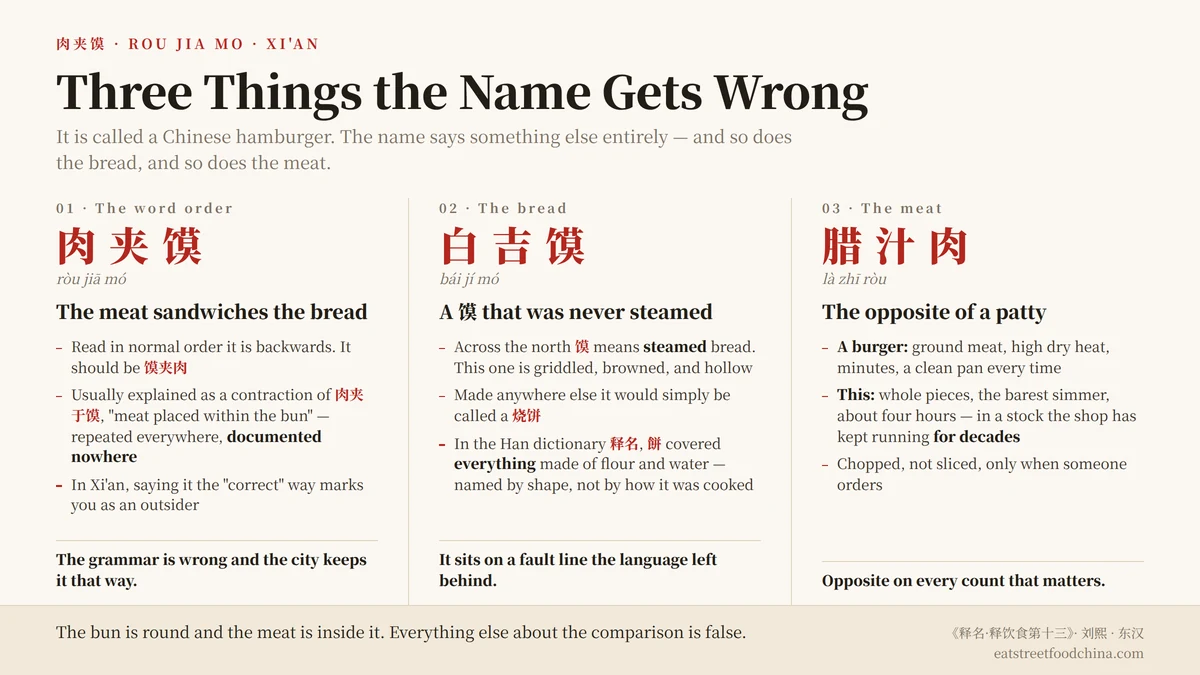
Read literally, the name is backwards
The three characters are 肉 (meat), 夹 (to clamp, to sandwich, to hold between), 馍 (the bun). Read in normal Chinese word order, subject then verb then object, 肉夹馍 says: the meat sandwiches the bread.
It is the bread that holds the meat. The name should be 馍夹肉.
Ask in Xi’an and you will usually get one of two answers. The first is that the phrase is a contraction of 肉夹于馍 — “meat placed within the bun” — where 于 is a classical preposition meaning “in” or “at,” and dropping it in speech leaves the three characters stranded in an order that no longer parses by modern rules. The second is simply that this is how it has always been said, and that saying 馍夹肉 marks you instantly as not from here.
Both answers are worth taking seriously, but they are different kinds of claim. The first is an etymology. The second is a fact about how the phrase functions now, and it is the one that can actually be observed: in Xi’an the word order is a shibboleth. Locals do not say 馍夹肉. Getting it “right” by the rules of grammar gets it wrong by the rules of the street.
What is missing is documentation. The 于-ellipsis explanation is repeated constantly and attributed to nothing. No early text records the phrase. It may well be correct — the ellipsis is a real pattern in Chinese — but it should be described as the explanation people give, not as a fact that has been established.
The bun is not what 馍 usually means
Across most of northern China, 馍 means steamed bread — the soft, white, pillowy kind that comes out of a bamboo steamer.
The bun in rou jia mo is not steamed. 白吉馍 (baiji mo) is cooked on a griddle, browned on both sides, and finished with dry heat. It comes out firm, faintly crisp on the outside, and hollow in the middle — which is the point, because the hollow is what holds the meat and its juices without collapsing. Made anywhere else in China, with the same flour and the same heat, this bread would be called a 烧饼: a griddle-baked flatbread. Xi’an calls it 馍 anyway.
This is not sloppiness. It is a fault line left over from a much older naming system.
In the Eastern Han dictionary 释名 (Shiming, “Explaining Names”), the entry for 餅 (bing) reads:
餅,并也,溲麵使合并也。
Bing means “to combine”: you wet the flour and make it come together.
Under that definition, 餅 was not a flat baked thing at all. It was the umbrella term for anything made by bringing flour together with water — and the same passage lists what fell under it:
蒸餅、湯餅、蠍餅、髓餅、金餅、索餅之屬,皆隨形而名之也。
Steamed bing, soup bing, xie bing, marrow bing, gold bing, cord bing and the like — all are named after their shape.
Steamed bread was 蒸餅. Boiled noodles were 湯餅. Both were 餅. The method of cooking was not what the word tracked; shape was.
The modern split — 馍 for steamed, 饼 for flat and baked — came later, and it never went through cleanly everywhere. 白吉馍 is one of the places the old boundary is still visible. Calling a griddle-baked bread 馍 is only strange if you assume the categories were always the ones we use now.
The assumption catches people going the other way too. A 月饼 is a 饼, and English renders it mooncake — but mooncakes are dense molded pastry with no cake in them anywhere. Same mismatch, running in reverse.
“Chinese hamburger” gets the meat backwards
Search in English and this dish is a Chinese hamburger. It is on menus that way, on Wikipedia that way, and in most of the recipe posts that way.
As shorthand for “meat in a bun, eaten in the hand” the comparison is doing honest work. As a description of the food it points in exactly the wrong direction, because the two dishes are made by opposite methods.
A hamburger patty is ground meat, formed, and cooked fast over high dry heat. Searing is the whole technique. It takes minutes, and it happens once, to that piece of meat, for that sandwich.
腊汁肉 (lazhi rou), the filling in rou jia mo, is the reverse on every count. Pork belly or rib meat goes in whole, in large pieces, into a pot of stock with a spice bag — star anise, Sichuan pepper, cassia, clove, tsaoko, fennel, and others depending on the shop. It is brought to a boil, then dropped to the barest simmer for hours, skimmed repeatedly, turned partway through, then lifted out and boned. Only at the very end, when a customer orders, is it chopped on a board and pressed into the bun.
And the stock is not discarded. It is strained, kept, and used again the next day, and the day after. A 腊汁肉 shop’s stock is a continuous thing, topped up and re-spiced but never started over, and the good shops measure its age in decades.
So: ground versus whole. Minutes versus hours. Dry heat versus liquid. A fresh pan every time versus a stock older than most of the customers.
The bun is round and the meat is inside it. Everything else about the comparison is false.
“One of the world’s oldest hamburgers” does not survive contact with the sources
The English Wikipedia article states that the bread dates to the Qin dynasty (221–206 BC) and the meat to the Zhou (1045–256 BC), and calls rou jia mo one of the world’s oldest hamburgers. The claim is cited to three English-language food articles from 2015 and 2020. Wikipedia itself tags one of them with an unreliable-source flag.
Set aside the sourcing for a moment, because there is a deeper problem with the shape of the argument.
The claim works by taking the dish apart and dating the pieces separately. Wheat bread: old. Braised pork: old. Therefore the sandwich: old.
That reasoning would make almost any dish ancient. Noodles are old and chili oil is old, but 担担面 is not therefore two thousand years old. The interesting question about any composed dish is when the composition appears — when someone first put these particular things together and gave the result a name. That question is answered by finding the dish named in a text, and for rou jia mo, no early text has been produced. The Qin and Zhou dates are dates for ingredients, not for a dish.
The honest position is narrower and more useful. The components are genuinely ancient and well documented: wheat, milling, and the whole 餅 family are all attested in Han-dynasty sources. The braising method is old. The bread is a survival of an older naming system. When rou jia mo became rou jia mo, as a named street food sold this way, is not something the surviving record settles — and no one who says “Qin dynasty” is working from a source that says so.
How it is actually made
Two components, prepared separately, joined at the moment of sale.
The meat. Pork with a good fat-to-lean ratio — belly, or rib meat with the bone still in — soaked in cold water until the water runs clear, which is what keeps the finished braise from tasting of blood. It goes into the old stock skin-side up with a spice bag, rice wine, soy, salt, ginger and scallion, weighted down so it stays submerged. Boil, skim, then the smallest possible simmer for roughly two hours; turn the meat, add rock sugar, simmer around two hours more. Out of the pot, bones pulled, meat rested. It should be soft enough to give under the side of a cleaver, not falling apart.
The bun. A firm, low-hydration dough, portioned and rolled into flat discs. Onto a dry griddle first, to set and color both faces, then finished with enclosing heat until it puffs and separates internally. Correctly made it has a thin skin, a hollow center, and enough structure to be split without tearing.
Assembly. The bun is split most of the way through, leaving a hinge. The meat is chopped — chopped, not sliced — with a few spoonfuls of the braising liquid worked into it, and packed in. Some shops add chopped green chili or cilantro; in Xi’an many do not. The bread should be hot enough that the fat starts to melt into the crumb as you carry it away.
The failure modes are specific. A bun cooked only on the griddle stays dense and will not hollow. Meat that has been boiled hard rather than simmered goes stringy. And a stock that has been started fresh tastes thin no matter how good the spice mix is, which is the whole reason shops guard the old one.a griddle- or oven-baked flatbread
What this dish is not
Three neighbours are easy to confuse with it, and each is a different thing.
羊肉泡馍 (yangrou paomo) also involves a 馍 and also involves long-cooked meat, but the bread there is a different, unleavened, denser bun that the diner tears into small pieces by hand before mutton broth is cooked into it. It is a bowl and a spoon, eaten sitting down. Rou jia mo is a hand and a walk.
锅盔 (guokui) is a Shaanxi and Sichuan flatbread built in layers and cooked in stages. Bigger, drier, structurally different, and not the bread used here.
烧饼 (shaobing) is the general northern term for a griddle- or oven-baked flatbread — the category 白吉馍 would belong to anywhere but Xi’an, as described above.
Frequently Asked Questions
Is rou jia mo really the world’s oldest hamburger?
No source supports that. The claim comes from dating the bread and the meat separately and treating the result as the age of the dish. The ingredients and methods are genuinely ancient; the composed, named street food is not documented in any early text that has been produced.
Why is the name backwards?
The usual explanation is that 肉夹馍 is a contraction of 肉夹于馍, “meat placed within the bun,” with the classical preposition 于 dropped. That explanation is plausible and universally repeated, but it is not documented in any early source. What is certain is that the order is fixed in Xi’an speech, and saying 馍夹肉 marks you as an outsider.
Is the bun steamed?
No. 白吉馍 is cooked on a griddle and finished with dry heat, which is why it is firm and hollow rather than soft. Elsewhere in China this bread would be called a 烧饼; 馍 in most of the north means steamed bread.
What kind of meat is it?
Pork, in the standard Xi’an version — belly or rib meat, braised for hours in a spiced stock that the shop reuses indefinitely. Xi’an’s Muslim quarter sells a beef version, which is a genuine parallel tradition rather than a substitute.
Can the braising stock really be decades old?
Yes, in the sense that matters: it is strained, kept, replenished and re-spiced continuously rather than being made from scratch each day. Nothing in a pot from 1960 is still there. What persists is an unbroken line of descent, the same way a sourdough starter is old.
Sources
释名 (Shiming), Liu Xi, Eastern Han — 释饮食第十三
说文解字 (Shuowen Jiezi), Xu Shen, Eastern Han