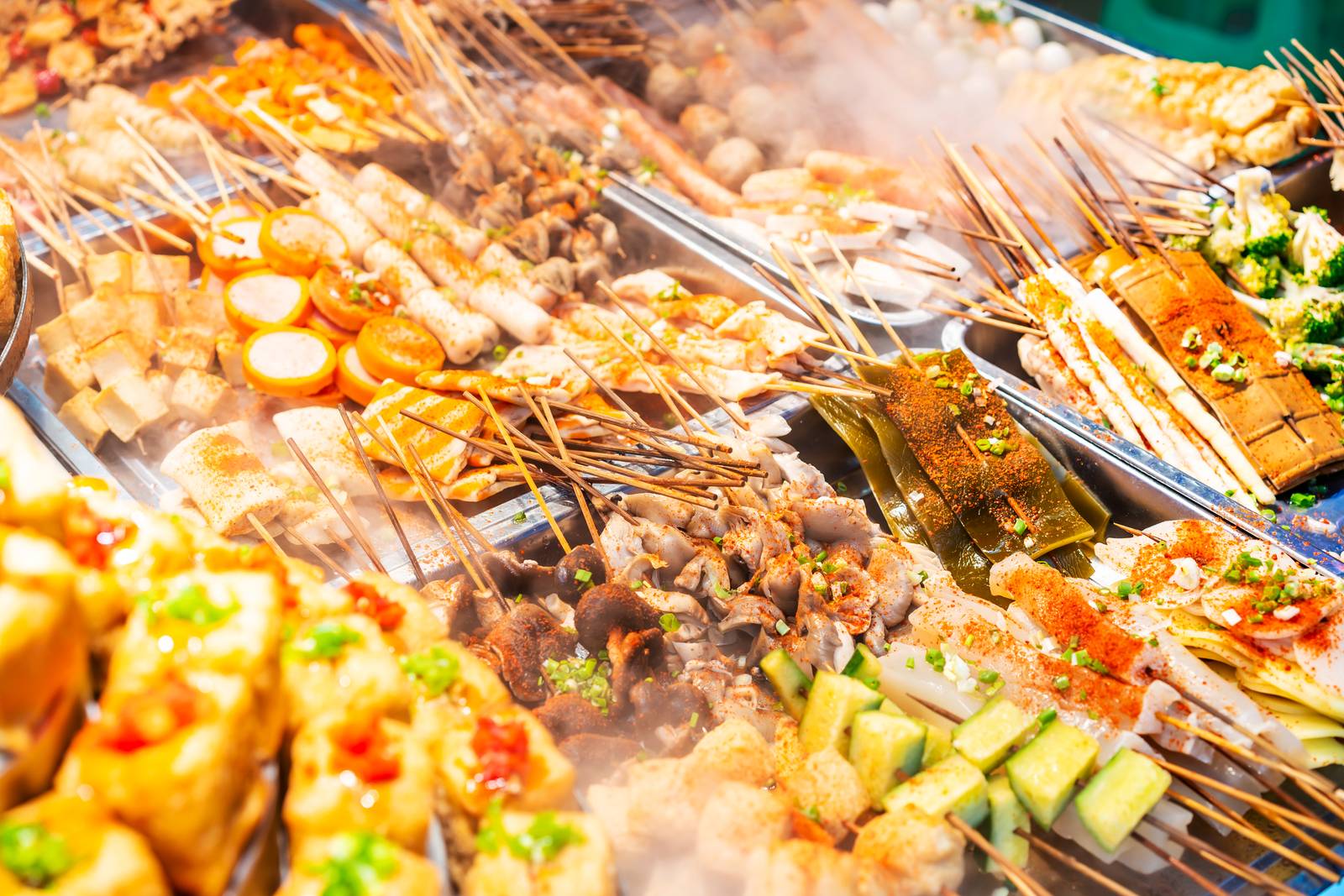
In chuan chuan (串串), the bamboo stick is part utensil, part portion marker, and part ordering system. Slices of meat, offal, tofu products, mushrooms, and vegetables are threaded in small quantities so diners can combine many ingredients without committing to a full plate of any one item.
The name covers more than one way of cooking. Chuan chuan xiang (串串香) usually places the skewers in a hotpot-like broth. Lengguo chuan chuan (冷锅串串) is commonly cooked in the kitchen and served ready to eat. A documented Chongqing snack style cools cooked skewers and coats or dips them in a red-oil dressing. The stick links these branches.
A name built from the skewer
The character chuan (串) depicts objects joined in a line. It functions as a verb, “to thread,” and as a measure word for skewered items. Repetition turns it into the informal name chuan chuan: one little skewer after another.
This format affects the meal before any ingredient reaches the pot. Beef, tripe, chicken gizzard, tofu skin, lotus root, potato, mushrooms, and greens can all be divided into small units. The sticks keep delicate or irregular pieces manageable, help separate cooking times, and provide a practical way to count or sort what has been eaten. Some restaurants now charge by weight or use other systems, but the visual logic remains the same.
Chuan chuan therefore has no compulsory centerpiece. Variety, selected in small portions, is the working principle.
The red-oil Chongqing record
An early twenty-first-century Chongqing description preserves a form that looks more like a prepared snack than a tabletop meal. Meat and vegetables are cooked first, allowed to cool, and threaded onto short bamboo sticks. At serving, the skewers meet a dressing made with red chili oil, Sichuan pepper, sesame, soy sauce, sugar, salt, and scallion.
That record matters because it captures a branch easily overlooked in present-day English explanations. It does not define all chuan chuan. Instead, it shows that skewering and mala seasoning could organize the food even when diners were not cooking around a bubbling pot.
From chuan chuan xiang to cold-pot service
The version most widely recognized today is chuan chuan xiang. Raw or partly prepared skewers arrive at the table and cook in a shared spicy broth. Diners retrieve each stick when its ingredient is ready and may dip the food in a second sauce. The social arrangement resembles hotpot, but the ingredients have already been portioned and threaded.
Lengguo chuan chuan shifts more work to the kitchen. The literal translation, “cold-pot chuan chuan,” can be misleading: the name distinguishes a service format and does not guarantee that the dish will be cold. Cooked skewers may arrive in a seasoned liquid or in a vessel that is no longer heated at the table. Depending on the shop, the ingredients stay on their sticks or are removed before serving.
Other local styles blur these lines. Restaurant labels are useful guides, not a fixed taxonomy for every city and period.
Comparing chuan chuan, hotpot, and malatang
All three can draw on similar ingredients and mala broths. The clearest differences usually lie in portioning, who cooks, and how the meal is shared.
| Feature | Chuan chuan / chuan chuan xiang | Hotpot | Malatang |
|---|---|---|---|
| Ingredient format | Small portions threaded on sticks | Mostly unskewered plates or baskets | Individually selected ingredients, usually unskewered |
| Cooking | At the table in a shared pot, or cooked by the kitchen depending on the branch | Usually cooked by diners in a shared tabletop pot | Usually cooked together by the vendor |
| Serving unit | Individual skewers; counting or weighing systems vary | Shared plates and pot | Usually an individual bowl |
| Social structure | Often communal, with many small choices | Strongly communal | Often individual or quick-service |
| Defining idea | The skewer organizes selection and cooking | The shared simmering pot organizes the meal | The vendor combines a customer’s selection into one seasoned serving |
Chuan chuan often feels like hotpot reduced to smaller units, although scale is only part of the distinction. Pre-threading governs portions and handling. Malatang may offer an equally wide display, but a vendor commonly cooks the customer’s unskewered selection and returns it together in one bowl. In tabletop chuan chuan, diners continue to manage separate sticks around a shared pot.
A food shared across Sichuan and Chongqing
Chengdu is prominent in accounts of chuan chuan xiang, while Chongqing supports hotpot-style businesses as well as records of dressed skewers. People, restaurant practices, and mala seasoning have moved continuously through the connected Sichuan–Chongqing region, allowing the format to spread and change.
The evidence is firmer on local forms and periods of popularity than on a single invention. One Chongqing account describes mala chuan chuan as recently fashionable when it was written and gives precise instructions for a dressed version. That establishes local use at a particular time. It cannot prove that the whole category began in Chongqing. Founder stories attached to later businesses have the same limitation when they are used to explain every branch.
Following the stick is more productive than assigning ownership. In both Sichuan and Chongqing, skewering turns a broad ingredient display into small choices suited to a snack, a casual group meal, or a full hotpot-style restaurant.
Mala changes with the service method
Chili heat and Sichuan pepper numbness provide the most familiar flavor direction. For chuan chuan xiang, the broth may contain dried chili, Sichuan pepper, fermented bean paste, aromatics, and animal or vegetable fat. The dressed Chongqing form reaches a related flavor through red chili oil, ground pepper, sesame, soy, sugar, and scallions, without a simmering broth at the table.
Ingredients respond differently. Tofu skin and leafy vegetables hold seasoning on the surface. Lotus root keeps a crisp bite; potato softens and absorbs the broth. Tripe and gizzard demand attention to cooking time. Thin beef can be wrapped around herbs or vegetables before it is skewered. Small portions allow those differences to share one meal.
“Spicy skewers” is useful supporting language, but it can suggest grilled kebabs. “Sichuan–Chongqing skewer hotpot” fits chuan chuan xiang and excludes the prepared branches. Keeping the name chuan chuan avoids choosing the wrong cooking verb.
The bamboo stick already supplies a durable definition. Broth, dressing, temperature, and restaurant format can change around it; the ingredients still arrive as a sequence of small threaded choices.
Related Sichuan–Chongqing Food Histories
Chuan chuan is closely associated with Chengdu, yet its skewer-and-broth format now sits across the wider Sichuan–Chongqing food world. The Chengdu Cuisine guide places it within the city’s broader snack culture, while the Chongqing Cuisine guide shows how skewers, noodles, and seasoned bowls form distinct but related local systems. Compare another cross-regional red-oil form in Hongyou Chaoshou, or the concentrated bowl-seasoning logic of Chongqing Xiaomian.